
Introduction
One week ago I crossed the London Marathon finish line in 3:07:16. In the lead-up to the race I was in two minds: to target a sub-3, or to settle for a Good for Age. At 59, the M55 GFA standard is 3:12, so anything under 3:10 would hopefully secure my place for next year. But could I push on and secure a sub-3 in the process?
By race morning I’d made my mind up. I was going to focus on the GFA. Pushing on for the sub-3 was an unnecessary risk due to these six factors:
- An all-inclusive holiday in Madeira two weeks before the race where I’d done next to nothing and eaten next to everything. I felt lethargic and stiff on my return, particularly in my left calf, and I couldn’t fully shake it before the race.
- It was a fairly warm day and I’m a bigger runner at just under 80 kg, so I knew this probably wasn’t going to be optimal conditions for me to make a big sub-3 effort.
- London is notoriously crowded and I was starting at the back of Wave 3 in a very busy field.
- Vätternrundan (a 200 mile cycle sportive in Sweden) was looming large at the start of June and I needed to be able to start logging some serious miles on the bike as soon as London was done. I couldn’t afford too much downtime.
- I had changed my insulin pump set up (I am a Type 1 diabetic) in the middle of March and was still getting used to managing my blood sugars during prolonged marathon pace efforts.
- Most importantly, what would a sub-3 at 59 actually mean to me? Sub-3 at 60 had a better, more alliterative, ring to it and there are far fewer runners breaking three in the M60 age category. I figured saving myself would make for a better, more meaningful challenge, and then I could go for it properly next year.
So I ran London as a very hard training run and enjoyed the sights and sounds. I set off for a 3:07 or 3:08, enough to bank another GFA, while I waited to see how my body reacted to this pace after a 16-week marathon training block before committing to a full sub-3 attempt again.
I finished London in 3:07:16, but more importantly I finished in good shape. Two days later I was able to jog around a local 10k in 50 minutes with my legs feeling pretty good and I managed to log 160 miles on the bike that week. After Edinburgh Marathon last May, I could barely walk for three days. That alone was enough to tell me what this marathon build had achieved.
But there’s more to analyse from the race and the build than how my legs felt afterwards. So this blog post, and my new soon-to-be-launched YouTube channel Sub 3 at 60, will be a dissection of a controlled marathon race and how to build a base of sustainable, durable running at 59 that sets up a genuine sub-3 attempt at 60. That’s pretty niche I know. So I’m hoping there will be broader lessons for masters runners who are chasing challenging goals too.
A bit of context first. I have only ever run one sub-3 marathon before. That was a 2:59:15 at Boston in 2022. I also once ran 3:00:07 at London, pre-super shoes, and finished the Manchester Marathon in 2:59:45 (also pre-super shoes) only for the course to be judged 380 metres short two years later. So I’ve been there or thereabouts a few times but never really done the proper training to achieve my true potential.
I usually don’t enjoy racking up mileage. I prefer running faster: intervals, repetitions, shorter stuff. So building deliberate mileage for this block was genuinely new territory for me.
At 60, will I have I left it too late to have a proper go at sub 3? My 2:59:15 was four years ago and that was a pretty close call. I don’t have time on my side, but I do have the opportunity to train more intelligently this time. And the shoes are getting better!
The build: 16 weeks of deliberate mileage
My plan this time around was simple: aim for an average of at least 40 miles per week for 16 weeks, regardless of pace. Workouts were optional depending on how I felt. Accumulating mileage was not.
Forty miles might not sound much. Most runners going sub-3 would consider it woefully inadequate. But when I ran Boston in 2:59, I averaged 35 miles a week over the previous 16 weeks. When I qualified for this year’s London by running Edinburgh in May 2025, I averaged 27 miles a week and still managed a 3:09:53 GFA, although it hurt like hell. I was running at 6:50 minute-mile pace for the first 18 miles, enjoying myself, then I turned into a headwind and hailstones. It was four Scottish seasons in one day. The last eight miles were me crawling along just trying to keep my legs moving. I don’t want to do that again.
One reason I can get away with low mileage at all is that I do a lot of cycling. Racing on Zwift in winter with Zwift Team Type 1, commuting and recreational riding in summer. I’ve got a reasonably strong aerobic engine from nearly 50 years of being active. It’s the durability, the muscles, tendons and ligaments, that lets me down in the marathon. So this block was about building that.
My 16-week mileage build based on runalyse.com data
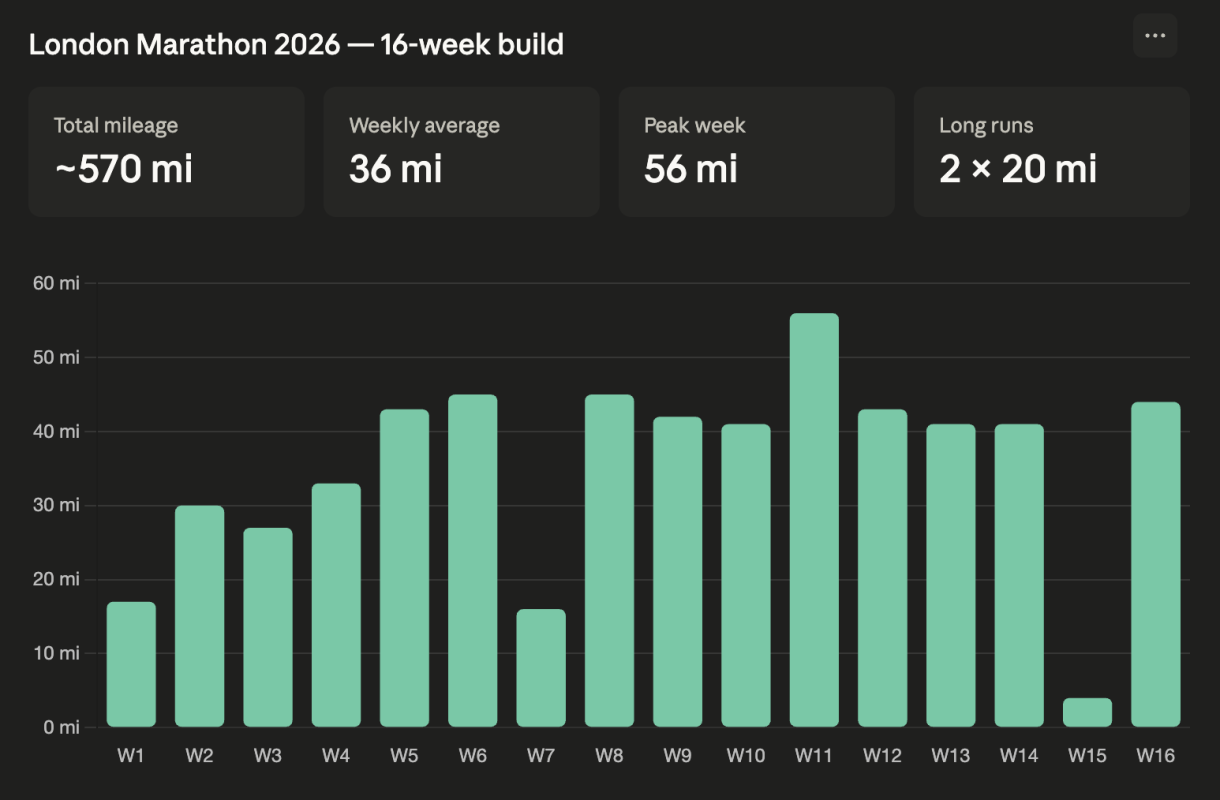
So how did I do in relation to my 40 miles per week aim? I averaged 36 miles per week across the 16 weeks. Not quite 40, but the median was 42. Two specific weeks dragged the overall mean down.
Week 7 and Week 15: sickness and life
Week 7 was illness. Man flu. You can’t do much about that. I attempted minimal mileage, got myself better, and jumped straight back on the 40-mile bandwagon the following week. The lesson, which I’ve learned the hard way over the years, is don’t panic when you have a down week, don’t try to make up the miles, just ease yourself back in gradually.
Week 15 was Madeira. An Easter holiday with my daughter, who is 11. She can run a mile or two, and we did two little runs together, but the rest of the holiday was just being on holiday with my daughter, which is what it should be. Was it ideal timing two weeks out from London? No. Would I do it again? Absolutely. Being a masters runner, being a normal runner, means life taking precedence over training.
Coming back from Madeira, I forgot the lesson about easing myself back into the mileage gradually. I panicked and tried some Marathon Pace work straight away and my body wasn’t having any of it. My left calf tightened immediately, I needed two sports massages that week from Luke at Pain Release Practice, and there were a few days where I genuinely wasn’t sure I’d make the start line. That’s the reality of a dramatic reduction in load at 59. Your body gets used to what you’ve been doing, and it doesn’t like a sudden change in either direction.
Managing old age: injuries, load, and smart training
Sciatica and proximal hamstring tendinopathy
I have had ongoing sciatica and proximal hamstring tendinopathy issues throughout this block. I had them in the build for Boston 2022 as well. Too much sitting exacerbates the problem for me. I try to stand as much as possible and have a standing lectern for my computer, but a flight to Madeira, a drive to the airport, hours of desk work, means there is not always a chance to stand and move. On a run the pain would typically start around mile 6 and then start to build. Sports massage helped, gentle movement helped, and avoiding aggressive stretching in favour of easy dynamic movement helped. I learned to warm up slowly and thoroughly before going for a run — even when in a rush.
What worked for me to manage the pain:
- Sports massage to release the quad and hamstring tension.
- Avoiding prolonged sitting
- Thorough warm ups
- Easy dynamic movements rather than aggressive stretching
- Continuing to run easy, and monitoring symptoms at speed and uphill
The day before the London Marathon I walked from King’s Cross to Chelsea Bridge with my bags. Probably five miles. Most people would tell you to stay off your feet the day before a marathon. For me, being on my feet was genuinely better than sitting around. It kept everything moving without depleting my energy reserves too much.
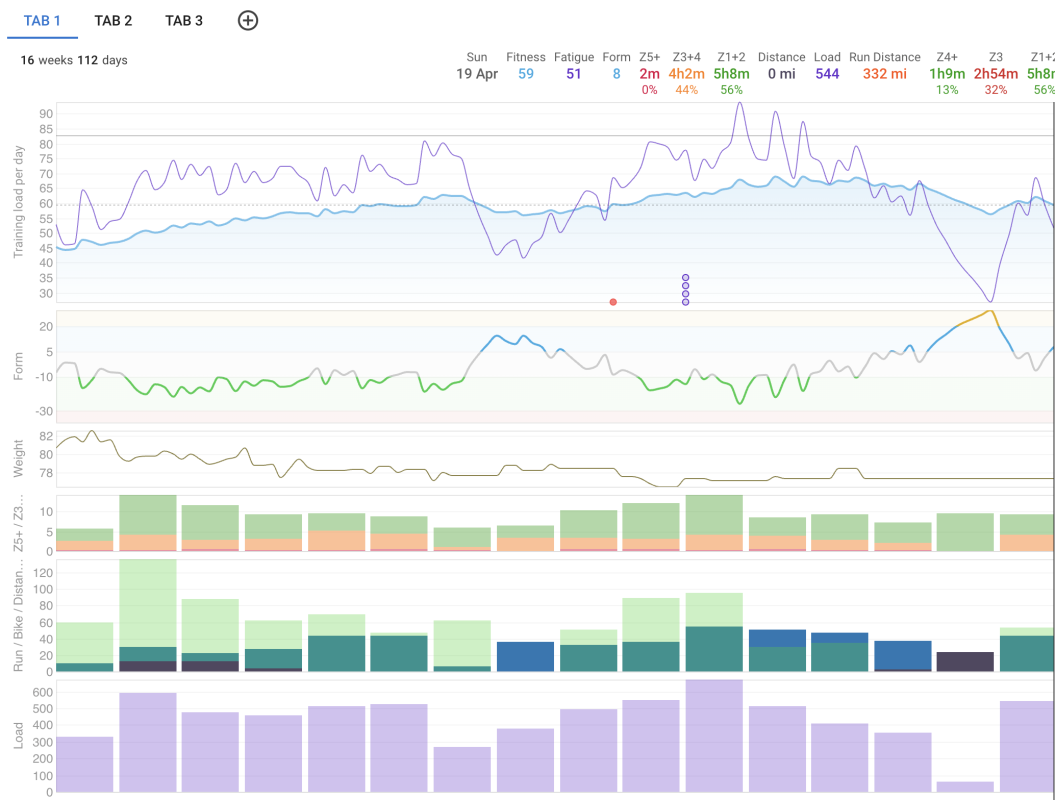
Intervals.icu training load chart showing fitness, fatigue and form across the 16-week block
Training load and weight
I use intervals.icu to track overall load, which includes all my cycling as well as running. You can see the blue line of my fitness load building steadily through the block, starting at 45 and peaking around 65, flattening out, and then the taper and the holiday in Madeira kicking in. Fatigue was managed throughout, and form was just turning positive into race week.
My weight is also displayed with the intervals.icu load data. You can see it dropped from 82.5 kg at the start of the marathon block to 77.5 kg before the all-inclusive splurge in Madeira. I didn’t dare weigh myself again after that.
There is no doubt that being lighter made a difference. I have a Garmin Index scale and hop on it once a week when I remember. There was no dramatic dieting or zealous carb counting, just fairly healthy eating of a varied diet and near-zero alcohol for the duration.
I was hoping the no-alcohol would fix my sleep as well. It didn’t. I still wake up at 2am and lie awake for a couple of hours listening to running podcasts most nights. But I feel better overall and I’m keeping the sober-ish lifestyle going this year. Caffeine is the next drug I need to kick.
Race day execution: pacing with discipline
So I set off at London aiming for around 3:07 to 3:08. The Madeira disruption and the warm conditions made going easier feel like the right call. The crowded course also made it difficult to find a clean running line, particularly in the first half. I was at the very back of Wave 3 and didn’t catch the 3:10 pacer who started at the front of my wave until mile 15!
5K Splits from the London Marathon App
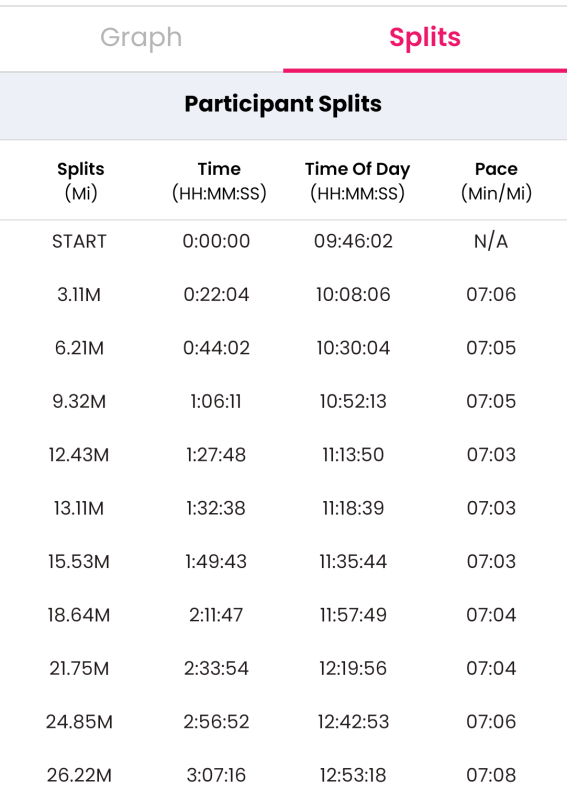
The splits tell a consistent pacing story:
- Miles 0 to 6: a controlled opener right on target but with a nagging thought in the back of my mind that pushing faster towards 6:50 min/mile and settling into sub-3 pace might be a good idea.
- Miles 6 to 13: 7:03 average. The noise from the crowds drowned out the sub-3 voices in my head. I locked in on the GFA goal of 3:08 or better, relaxing into the rhythm and ignoring the dubious mile splits on my watch.
- Miles 13 to 24: solid 7:03 to 7:04. The body was fine; the fuelling had been good and the pacing discipline held.
- Final 2 miles: slight fade as my hips started complaining, but nothing dramatic.
Heart Rate Data
I like running to heart rate. It stops me pushing too hard early on in a race and in training it provides a reliable idea of where my fitness is at. I wore a Garmin HRM Pro Plus heart rate strap for most training runs and for the London Marathon itself.
My heart rate sat at around 146-148 bpm for most of the race. I averaged 147 and was well below my threshold (~160 bpm). It was clear from a cardiovascular perspective that I was running within myself, and it’s the principal reason why my pacing was so even.
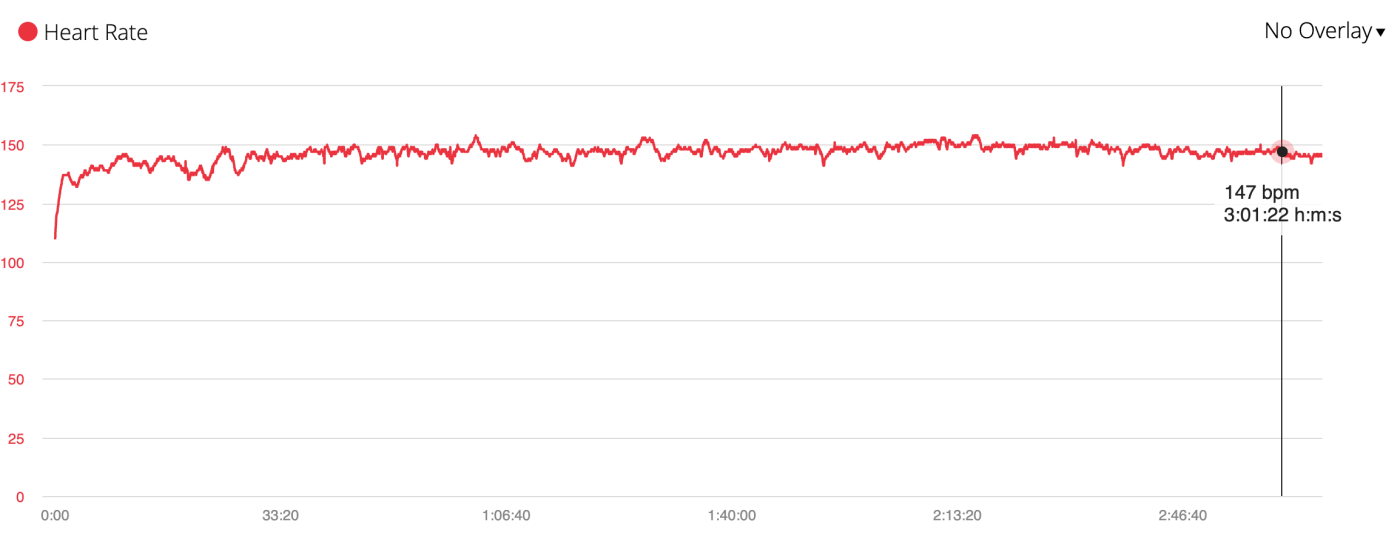
Although my heart rate was comfortable throughout, my body started to feel uncomfortable at mile 24. The last two miles I definitely wanted to see the finish, but I never felt like I was falling apart. That had to be the durability work doing its job: boringly consistent, mostly Zone 2 mileage, not much speed work, with Spen 20 and the Liversedge Half as my main marathon-pace efforts along the way. It was not glamorous training full of sexy track workouts. It was bread and butter mileage that held my body together when it mattered.
Glucose management with diabetes: the hidden story
I have had Type 1 Diabetes since 2011 and since 2017 I have used an insulin pump. Most of you won’t be particularly interested in the detail of managing Type 1 diabetes through a marathon, but I include an overview of it here because it’s an important part of the story, and because I think it’s worth showing that managing a chronic condition within a competitive athletics environment is completely doable. All that’s required is a little more planning and a little more discipline. Plus the continuous blood sugar monitoring that is part and parcel of diabetes nowadays in the UK can actually become a benefit if you view it from the right perspective.
I moved to a CamAPS FX insulin pump and a Dexcom G6 continuous glucose monitor in March this year, which was my first experience of a hybrid closed loop system that afforded a lot more flexibility for blood glucose control. It was almost like having my pancreas back working again at times.
Carb loading with Type 1 diabetes
The standard marathon advice is carb load. For someone with Type 1 diabetes, it’s not that simple. More carbs means more insulin, and getting that balance right is genuinely tricky. Too much insulin active means hypoglycaemia. Not enough means high glucose and poor performance.
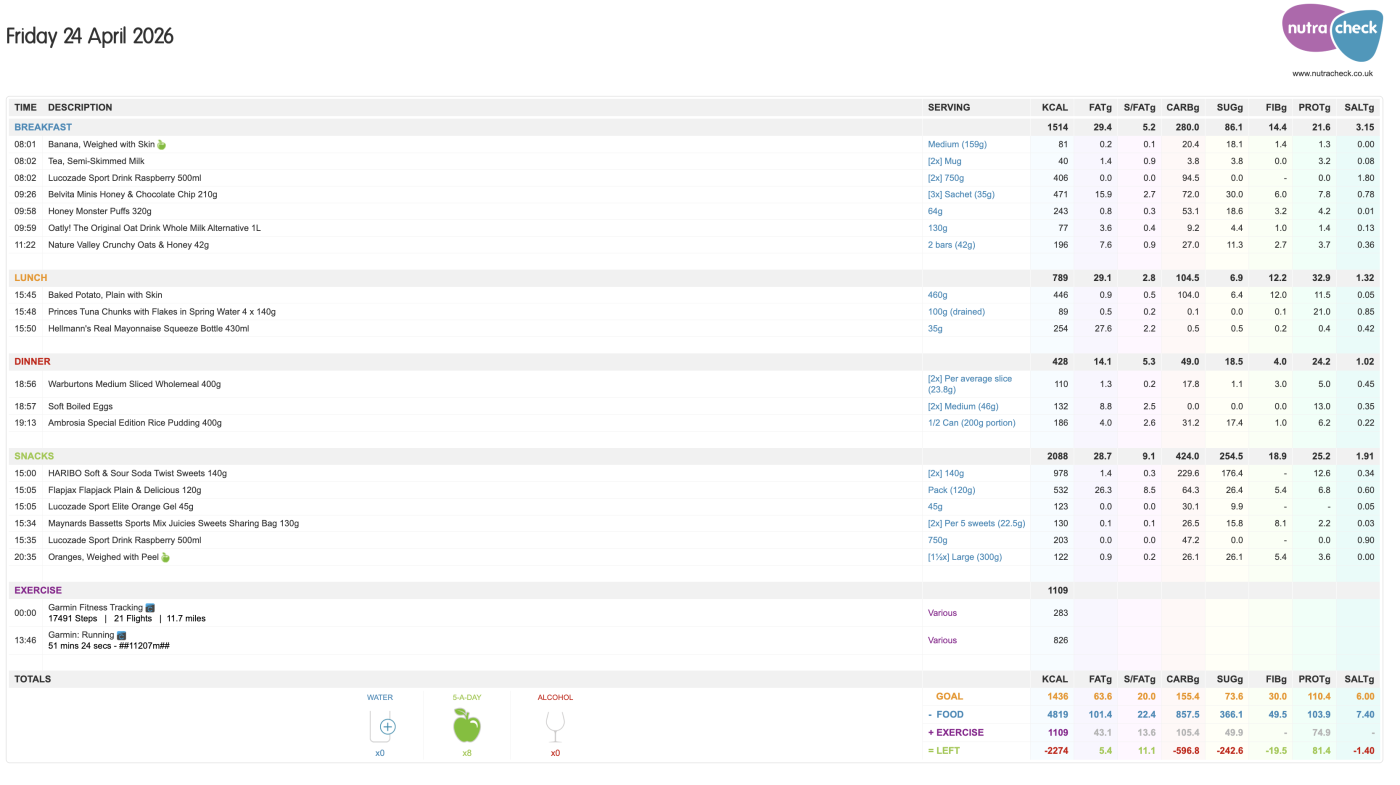
I logged everything meticulously using NutraCheck, targeting 800 grams of carbohydrate per day (roughly 10 grams per kilogram of bodyweight at 80 kg). Friday came in at 857g, Saturday at 825g. I’m not proud of some of what I ate to get there: Haribo, Lucozade, flapjacks, Nature Valley bars. Things I wouldn’t touch on a normal day. But the strategy worked.
Race day glucose management
My race day strategy:
- I left CamAPS operating normally. I did not use ease off because I found in the Spen 20 tune-up race my blood sugars would go too high in ease-off mode unless I applied a bolus.
- I took 30g of carbohydrate at the start and then every 5K via Lucozade gels, with the pump adjusting insulin accordingly each time. I also had a couple of cups of Lucozade Sport where it was available on the course.
- I performed no additional bolusing during the race.
Blood glucose values throughout the marathon
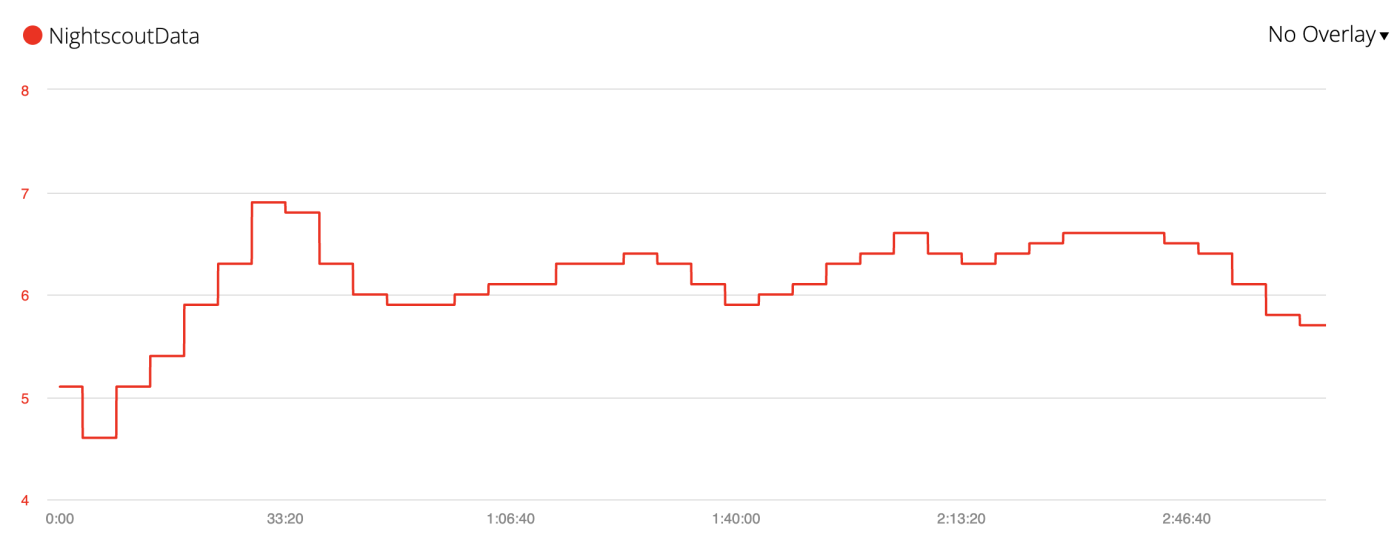
My continuous glucose monitor showed my blood glucose sitting between roughly 5 and 7 mmol/L (90 to 126 mg/dL) for virtually the entire race. The best I’ve ever managed in a marathon.
The result was stable blood glucose levels throughout and absolutely no hypoglycaemic episodes or need to bolus for highs. My fatigue in the final miles was muscular fatigue, rather than glycogen deficit. With the Dexcom G6 continuous glucose monitor relaying readings every five minutes to the watch on my wrist, what used to be a guessing game became genuinely manageable.
Implications for sub-3 at 60
I came to London as a 59-year-old who was on the cusp of cracking sub-3. I didn’t attempt it in the end, but I got a more valuable result instead: proof that my new marathon training system works. The build was sustainable. I ran over 500 miles in 16 weeks and stayed healthy. The pacing held throughout the race. I ran 26 miles at sub-7:10 pace with a controlled, comfortable effort. The glucose management was spot on. I finished with stable blood sugars and a functioning body. And I am ready one week later to resume full training and get back to 40 miles a week.
Durability is still my limiting factor, though London showed real improvement there. To go sub-3 in 2027 I will need more average mileage than 36 miles a week, and I’ll need to add proper marathon pace work on top of that base. Those are the two things I can actually control.
So the plan for the rest of the year is simple: accumulate 2,026 miles in 2026. That’s roughly 40 miles a week all year, which builds a much higher starting base for the January 2027 block. From there I can push the weekly total up to 55 or 60 miles, absorb more marathon pace work, and run longer long runs.
The Brass Monkey Half Marathon in January 2027 will be an attempt at an ambitious sub 1:20, then London 2027 will be my M60 sub-3 at 60 attempt all being well. There will be some racing milestones along the way this year but nothing important enough to derail my 2026 miles in 2026 goal.
The bigger picture
Racing at 59 is a privilege. I’m in a position now that I didn’t expect when I started as a young boy of eleven running cross country at school. I feel capable of running faster, training smarter, and becoming more durable than ever before. The next 12 months are about building a marathon base. But they’re also about doing what matters alongside the training: coaching the athletes at our club, running with my daughter, and treating the marathon as just one part of a life well lived rather than something that defines me.
If you’re a masters runner, or someone wondering whether you can still do hard things in your 50s and 60s, I will endeavour to show you that you can. It just requires discipline, a data-driven and health-first approach, and the willingness to manage injury, illness and life. The advantage of being 60 is the perspective it affords.
What’s next
I’m a firm believer in focusing on the process and letting the outcomes take care of themselves. A sub-3 at 60 would be a wonderful thing to have. But my priority is staying fit, healthy and enjoying my running while managing my diabetes.
So the process this year is maintaining 40 miles a week to build a stronger base for the London 2027 block. And I’m launching the Sub 3 at 60 YouTube channel to document it properly, starting with a full analysis of this London 2026 build: training, nutrition, cross training, rest, recovery, and race day decision making. The aim is to be honest about what ageing, performance and managing a health condition actually look like in practice.
Ian is a 59-year-old competitive masters runner, athletics coach, and person with Type 1 Diabetes. He completed Boston 2022 in 2:59:15, Edinburgh 2025 in 3:09:53, and London 2026 in 3:07:16. His goal is a sub-3 marathon again at 60 in 2027.