
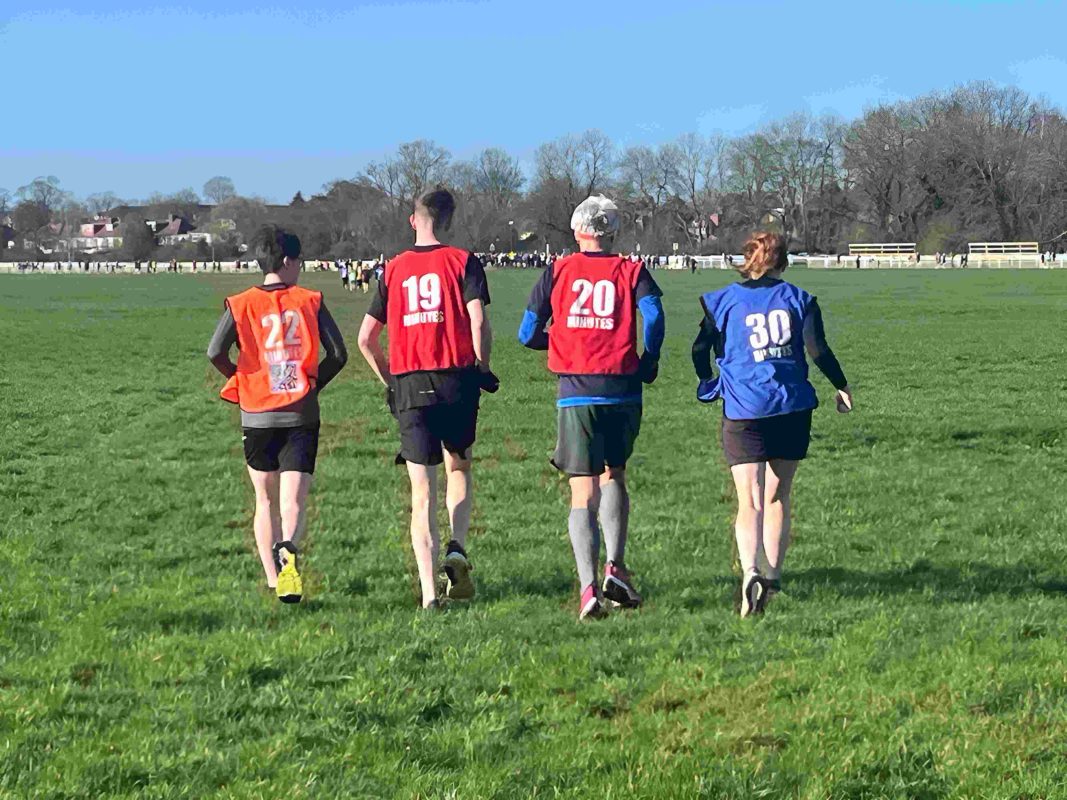
Vale of York members helped the University of York Athletics and Running Club out with a takeover of York parkrun on 14 March. We helped them fill a number of volunteer roles including pacing.
I chose to put on the iconic 20 minute volunteer vest and thought I’d take this opportunity to share with you the fundamentals of pacing a parkrun right. From both the perspective of a pace volunteer and the perspective of a runner after a presonal best time.
I cannot stress enough that correct pacing is the key to a good parkrun time. Not just a good parkrun time, but a good time in any endurance event. You must get your pacing strategy right from the start or else you are doomed to under perform.
Go too fast early on when you are feeling strong and you will burn the matches you need to light your fire when the going gets tough after half way.
If you can’t pace properly, you’re basically doomed to under perform. Pacing is so important for endurance athletes that Matt Fitzgerald has written an entire book about it.
What follows is my advice based on 50 years running experience and 20 years as an endurance coach. I’ll cover what is the best way to approach pacing at parkrun. And if you’re thinking about volunteering as a pacer at parkrun how do you fulfil the role with confidence.
Finding a Pace Group to Run With
My first piece of advice is that if you’re chasing a time goal, don’t just try to nail it on your own from the start. Find a pacing event and run with a pace group. There are actually quite a few of these around.
Selby parkrun hosts them regularly on the last Saturday of every month, which is handy. And then there’s York parkrun, which often has a whole range of pace groups depending on who’s volunteering that week. You’ll get anything from sub-19 minutes down to 30-plus minutes. It just depends.
Now, running with a group does more for you than just the psychological boost, though that’s definitely part of it. There’s actual physiological stuff going on too—well, not physiological exactly, but you know what I mean. Running in a pack shelters you from the wind, you get the rhythm of other people around you, and there’s something about it that just makes it easier. Running solo is so much harder. When you’re on your own, you have to be disciplined about it. With a group, you just settle in and let it happen.
Don’t Chase the Watch—Chase Your Effort
Here’s something that took me a while to get my head around properly: this isn’t about hitting exact splits on your watch. That’s actually the trap a lot of people fall into.
Think about it. The course is never flat. The wind isn’t always at your back. You’ve got hills, you’ve got terrain that changes, and if you’re constantly trying to hit a specific pace regardless of what’s happening around you, you’re going to exhaust yourself. You’ll be burning energy fighting against headwinds, burning energy climbing, burning energy just trying to hold a number on your watch.
What you actually want to do is keep your effort level consistent. That’s the real trick. It means:
- Into a headwind, you’re going to be slightly slower—but your effort stays the same
- With a tailwind or downhill, you might be moving faster—but again, the effort is the same
- You’re metering out your energy evenly across the whole race
This is a genuinely different way of thinking about it. You’re not glued to your watch; you’re checking it to make sure you’re in the ballpark, but your real focus is: am I working at the right level?
The Three Miles: How They Actually Feel
I’ve done this enough times now that I can talk you through what each section of the race should feel like. And honestly, understanding this changed how I approach pacing.
Mile 1: The Hardest Part (Even Though It Feels Easy)
This is where most people go wrong. Your legs feel fresh. Your lungs feel good. You look at your watch and think, “This is easy—I could go faster.” And that’s exactly when you need to pull back.
If you’ve set your pace right, that first mile is going to feel ridiculously easy. Embarrassingly easy. That’s not a mistake; that’s the whole point. The worst thing you can do is think, “I’m feeling good, so I’ll ramp up the pace now.” You’ll burn too many matches early on, and you will absolutely pay for it later.
So what do you do? You check your watch constantly. You make sure you’re hitting target pace. And you stay there even though it feels easy. Unless you’ve got a massive headwind pushing you or you’re going downhill, you rein yourself in. That first mile is everything. It’s about discipline—holding it steady, not going off too fast, because that’s what’s going to keep you strong when things actually get hard.
Mile 2: When the Work Actually Starts
Once you’ve got that first mile under your belt, mile two is a completely different mentality. In mile one, you were concentrating on holding yourself back. In mile two, you’re concentrating on actually putting some effort in—but in a controlled way.
This is where you start to feel it. Your pace hasn’t changed from mile one, but now you’re actually working. You’re focusing on staying relaxed, on running to your pace and your effort level, and there’s real work happening. It’s the difference between cruising and actually racing.
Mile 3: Just Hold On
Mile three is about hanging on. It will hurt at this point. But—and this is important—if you’ve paced the first two miles correctly, it shouldn’t hurt so much that you can’t hold your pace. You’re not completely gassed. You’re tired, yes, but you’re still in control.
And if you’re running in a group, the people around you will help you here. Words of encouragement from the pacer, from other runners who are in it with you—that actually matters. It makes a difference.
Why Volunteer as a Pacer?
I’ll be honest, I ended up volunteering as a pacer more or less by accident. A couple of weeks ago, we helped the University of York do a takeover at York parkrun, and they needed people to volunteer for pacing roles. I put my hand up for the iconic sub-20 group. It’s always popular—lots of people want to break 20 minutes—and I’ve run enough 5Ks that I thought I could keep a steady pace.
But here’s the thing: it’s actually rewarding in a way I didn’t quite expect.
It Should Be Comfortable for You
First off, if you’re pacing parkrun, it should feel relatively comfortable. You’re not supposed to be absolutely redlining it. Unless you’ve chosen completely the wrong pace for yourself, pacing shouldn’t be a struggle. It’s a volunteer role, so we’re not expecting perfection. It’s not like those pacers you see at Diamond League events, where they pace the first lap or two and then drop out. At parkrun, you’re generally expected to finish the race, ideally just under your pacing time, though honestly, your main job is just to do your best.
Your actual role is to maintain a steady, predictable pace. To shelter people from the wind. To offer encouragement. To make sure they know they can still hit their target because you’ve scheduled it and paced it correctly.
The Reward Is Real
At the York takeover, I had someone come up to me afterward and tell me they’d just got a 30-second personal best. Their first time under 20 minutes. That’s a proper PB—not a fluke, not a net time thing, but a genuine breakthrough. And knowing that I’d helped make that happen? That feels good.
I remember another pacer, Cameron, was running 19 minutes that day. Someone asked him how he could possibly talk while running 19 minutes for a parkrun. The answer is straightforward: he’s a 15-minute 5K runner. What’s a conversational pace for him is a hard effort for someone else. It’s all relative, right?
And look, I’m 59 years old. I’m pacing a 20-minute pace. People have said to me, “I can’t believe it. You’re a machine.” But I know 59-year-old runners doing 17 minutes for parkrun, and I’m genuinely in awe of them. We’re all at different points on the spectrum. What matters is that you’re volunteering, you’re putting back into the sport, and you’re helping people achieve their goals.
You Get Something Back
As a pacer, you earn a volunteer credit. You get your run in. You help someone succeed. When you’re 59 and someone tells you, “I can’t believe how fit you are,” there’s something nice about that. But more than that, there’s something genuinely good about knowing you helped someone cross a finish line faster than they thought they could.
It’s Worth Trying
If you haven’t run with a pacer or haven’t tried pacing yourself, I’d genuinely recommend giving it a go. Check out your local parkrun’s volunteer opportunities or find a pacing event near you. You might surprise yourself—and you’ll definitely surprise someone else.
Want to get involved with VoYAC? Find out how to join us and be part of a thriving running community.
