
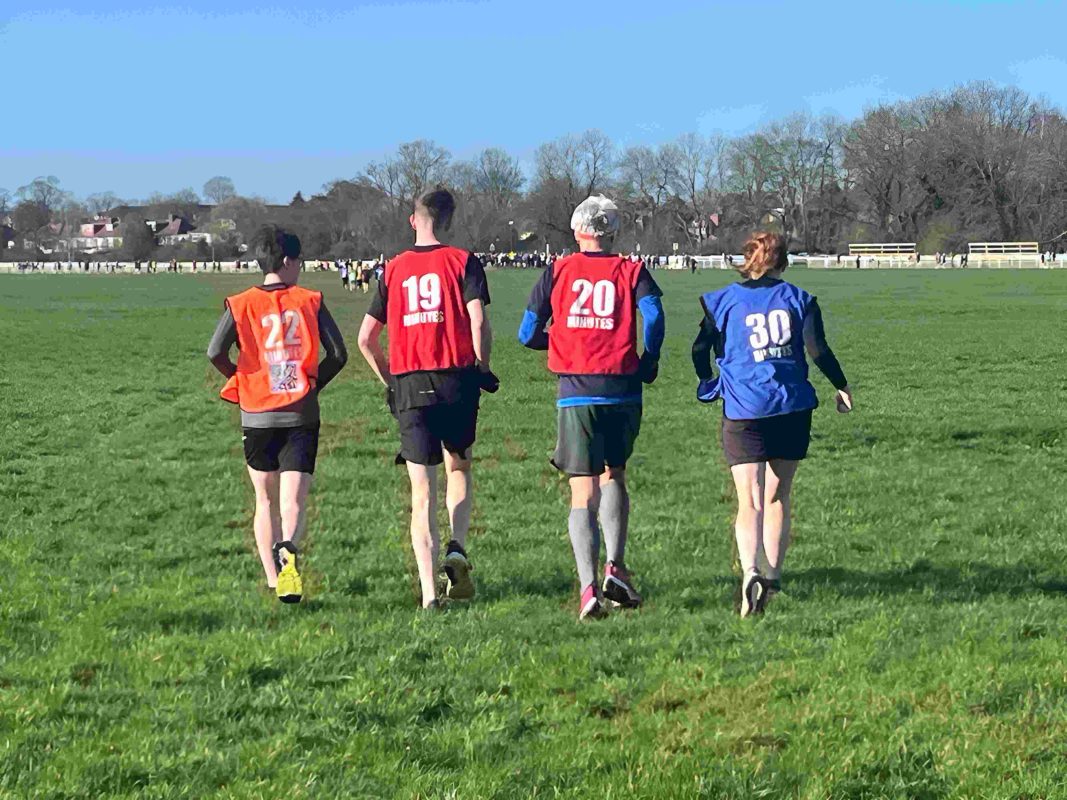
Vale of York members helped the University of York Athletics and Running Club with a volunteer takeover of York parkrun on 14 March. We filled a number of volunteer roles on the day including pacing.
Pacing is absolutely the key to a good parkrun time. Go out too fast and you’re doomed to underperform. Meter out your resources effectively from the start to the finish line and you’ll stand the best chance of achieving your time goal and fulfilling your running potential.
Success in all endurance events relies on a sensible pacing strategy. Pacing is so important for runners that Matt Fitzgerald has written an entire book about it.
Fitzgerald’s book is well worth a read. What follows is my own personal advice based on 50 years of running experience and 20 years as an endurance coach.
In my experience, most people go off way too fast and suffer physiologically and psychologically as a result. It’s a far more positive experience to start slower, feel comfortable and then start passing people than to toil backwards through the field.
Here are the ways in which you can curb your enthusiasm in the first couple of kilometres and execute a perfect pacing strategy.
Find a pace group
My first piece of advice if you’re chasing a time goal, is don’t do it alone. Find a parkrun pacing event and run with a pace group. Depending on where you live, there should be pacing opportunities at least once a month somewhere close by. The parkrun event pages don’t list any details of pacing events, but if you have a Facebook account details are usually posted on Facebook.
Running with a pace group does more than just slow you down early on when there’s the tendency to run too fast. There’s also the psychological boost of running with other people that reduces your perception of effort and locks you into a comfortable rhythm that makes everything seems easier. Running solo is so much harder, but in a group you can settle in and let the pacing happen.
Running in a pack also shelters you from the wind. We will come to the effect of wind on pacing next, but your job if you are after a PB is to stay out of the wind as much as possible. Let the parkrun pace volunteer or other stronger runners do the extra work.
And never be fooled into thinking there is no wind. If you can’t feel the wind, then it is likely to be behind you, pushing you along.
Selby parkrun hosts pacing events regularly on the last Saturday of every month. York parkrun often has a range of pace groups every week depending on who’s volunteering. Generally, you’ll get anything from sub-19 minutes down to 30-plus minutes. It just depends who has stepped forward that week.
Don’t be a slave to your watch
Correct pacing is not about hitting exact splits on your watch. It’s about keeping your effort level even and appropriate throughout the race.
GPS enabled watches have undoubtedly made the job of pacing much easier, but they are not the be all and end all of pacing. You must consider external factors that can effect your ability to hold an even pace and use your evaluation of these in conjunction with the pace on your watch.
Think about it. Parkruns are seldom flat. You’ve got hills, you’ve got terrain that changes underfoot. Even when you find a flat parkrun like York or Selby, the wind won’t always be at your back. Selby and York are both exposed to the wind and depending on the wind direction can be challenging runs as a result.
Even a small headwind increases your effort levels and has a demonstrable effect on your pace. A 2 mph headwind increases the effort a 20 minute parkrunner would need to produce from 4 min per km to 3:57 min/km. You can use the headwind and tailwind calculator at Running Writings to see what effect a 20 mph headwind would have on your effort levels to sustain a 4 min per km pace. I think you will be surprised!
So always keep in mind your perception of effort and environmental factors as well as glancing as your watch to check your average lap pace. If you’re trying to hold your target pace into a 20 mph headwind, you’re going to exhaust yourself. Burning unnecessary energy fighting headwinds and climbs to simply hold a number on your watch is bad pacing strategy.
If you use your watch and it displays heart rate reliably then use heart rate in conjunction with your perception of effort to judge how hard you are working. Just remember that heart rate will lag behind your effort levels for up to the first ten minutes of the race — depending on how warmed up you are before the start.
Whether you use heart rate or perception of effort, what you actually want to do is keep your effort level consistent throughout the race. That does not mean the perception will feel the same, but it does mean that your body will be working equally hard throughout.
In practice, this means:
- Into a headwind or uphill, you’re going to be slower but your effort stays the same
- With a tailwind or downhill, you might be moving faster but again, the effort is the same
- On grass or rough surfaces, you’re going to be slightly slower but your effort stays the same
This is genuinely different from running even splits. You’re not glued to the pace on your watch; you’re checking it to make sure you’re in the ballpark, but your real focus is on your heart rate and your perception. The one question you always need to be able to answer is: Am I working at the right level?
Pacing a parkrun in thirds
I’m 59, so I still work in miles. For me, a 5K parkrun is best broken down into three segments of a mile each. Don’t worry about the last 0.1 of a mile. By the time you get there you’ll have less than 200 metres to go and your pacing work is already done. At that point you go eyeballs out for the line and give it everything you have left in the tank.
Here’s how I approach each mile of a parkrun when I’m pacing or looking for my own PB.
Mile 1: The easiest and hardest mile
This first mile is where most pacing plans go awry. You feel fresh and you are eager and enthusiastic. Your body is pumped full of adrenaline and everywhere around you people are sprinting off from the start line like maniacs. You glance at your watch, see that you are well in front of your target pace, and think, “This feels easy. I could definitely go faster.”
That’s exactly when you need to rein in your ambition and pull back to your target pace.
If you’ve set your pace right, that first mile will feel ridiculously easy. That’s not a watch malfunction or you suddenly having improved your fitness; that’s what perfect pacing should feel like in Mile 1. The worst thing you can do is think, “I’m feeling good, so I’ll ramp up the pace now.” Burn too many matches early on, and you will be unable to light your fire later.
So what do you do? You check your watch constantly and make sure you’re not exceeding your target pace. Stay on pace even though it feels easy. Unless you’ve got a massive headwind pushing you or you’re going downhill, rein yourself in. The first mile is where your 5K whole race is built. In a short race you only have small margins for error, so stay disciplined and hold yourself steady. There’s plenty of time for more effort in Miles 2 and 3.
Mile 2: Controlled and relaxed racing
Once you’ve got that first mile under your belt, Mile 2 requires a different mentality. During Mile 1, you were concentrating on holding yourself back. In Mile 2, you need to concentrate on relaxing while putting in effort in a controlled manner. Depending on the course topology and terrain and the wind speed and direction, this is where you will start to feel the effort but it should not be unbearable.
Your pace hasn’t changed from mile one, but now you’re actually working. Focus on staying relaxed, on running to your correct pace and your effort level, and there’s real work happening. If Mile 1 was cruising, Mile 2 is racing.
Mile 3: Hold on
Mile three is about holding on. There’s no getting away from it but it is going to hurt at this point. But if you’ve paced the first two miles correctly and your goal is realistic for your fitness level, it shouldn’t hurt so much that you can’t hold your pace with a lot of effort. You may be tired and can’t wait for the end to come, but you’re still the boss of your body. You’re still in control.
If you’re running in a pace group, the people around you will help you here. Words of encouragement from the pacer and from other runners will make a difference. As will knowing that everyone, with the exception of the pacer, is suffering just like you.
Why volunteer as a pacer?
I’ve paced the iconic sub-20 group several time. It’s a popular time goal with lots of recreational runners aspiring to break 20 minutes. It’s also comfortably hard enough for me to run as part of my training as a threshold effort.
It should be comfortable for you
If you’re pacing parkrun, choose a pace that feels relatively comfortable for you. You’re not supposed to be going for your own personal best. Unless you’ve chosen completely the wrong pace for yourself, pacing shouldn’t be a struggle. Conversely don’t choose a pace that is too slow for you. It is difficult to run a lot slower than you are accustomed to and as a result you may struggle to keep an unnaturally slow rhythm.
Don’t worry if it’s your first time and the pacing doesn’t go to plan. It’s a volunteer role, and parkrun is not expecting perfection. You are not at the Diamond League. At parkrun, you’re generally expected to finish the race, ideally just under your pacing time, although your main job is just to do your best.
Try to maintain a steady, predictable pace that will bring the group home just under target. If you can account for the terrain, wind speed and direction to preserve a consistent effort level then even better. Shelter others from the wind and offer words of encouragement when you can. I like to shout out the kilometre and mile split times and let the group know they can still hit their target.
You get something back
At the York takeover, I had a runner from Snaith and Cowick come up to me afterward to shake my hand and tell me they’d just got a 30-second personal best. It was their first time under 20 minutes. Knowing that I’d helped make that happen felt good.
I also remember one of our University of York athletes, Cameron, was pacing 19 minutes that day. Someone asked him how he could possibly talk while running 19 minutes for a parkrun. The answer is simple: he’s a 15-minute 5K runner. What is a conversational pace for him at 6:06 min/mile pace is a hard effort for someone else. It’s all relative.
Whatever pace you volunteer for, what matters is that you’re volunteering, you’re putting back into the sport, and you’re helping people achieve their goals.
As a pacer, you earn a volunteer credit. You get your run in. You help someone succeed. When you’re 59 and someone tells you, “You are a machine,” there’s something nice about that. But more than that, there’s something genuinely good about knowing you helped someone cross a finish line faster than they thought they could.
Give pacing a go
If you haven’t run with a pacer or haven’t tried pacing yourself, I’d genuinely recommend giving it a go. Check out your local parkrun’s volunteer opportunities or find a pacing event near you.
If you happen to be close to Selby parkrun this weekend there’s a pacing even on. Come down and say hello or volunteer for a pacing role. I’ll be attempting 19 minutes… legs permitting!