
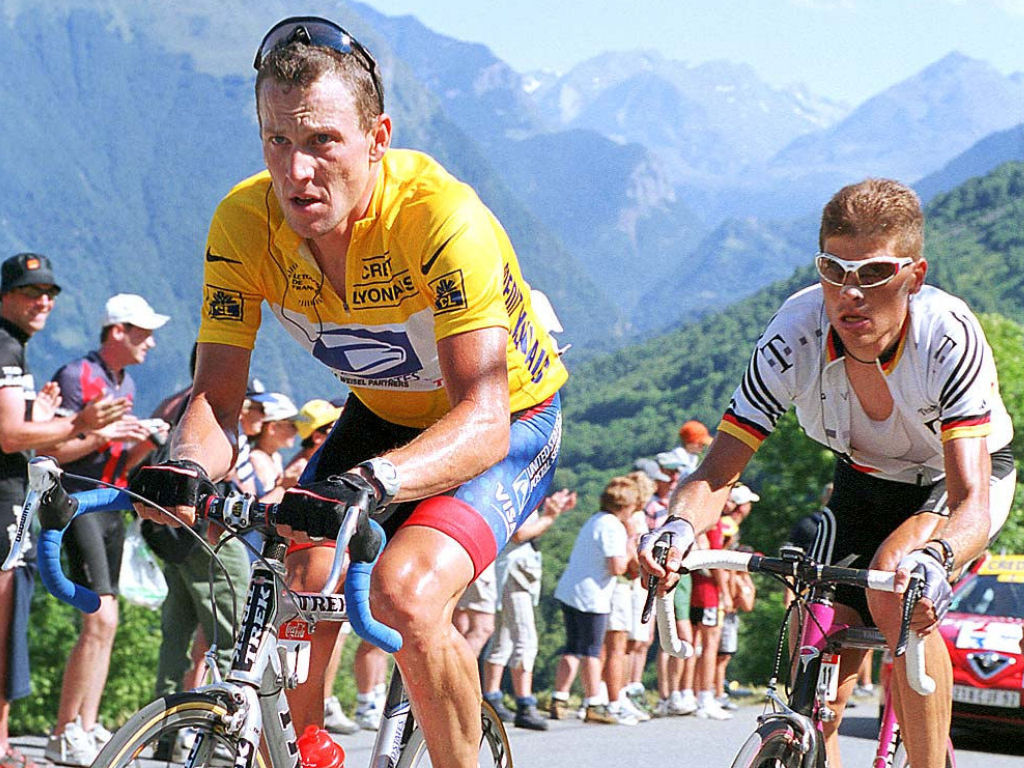
This week I’ve been re-reading Daniel Friebe’s biography of Jan Ullrich, The Best There Never Was. Ullrich was an interesting character. East German, and a something of a poster boy for cycling in unified Germany, he was a powerful rider, with masses of potential, who sadly spent most of his career riding in Lance Armstrong’s long shadow. Ullrich won the 1997 Tour de France aged 23 but never went on to win it again.
In Friebe’s book, the bit that really stands out for me is the description of Ullrich’s off-season.
Ullrich took the concept of an off-season to extremes. He would kick back and completely relax off the bike in winter, swinging from his race-ready Tour weight of 73kg to ten or more kilos heavier over winter. This included — according to cycling legend — a penchant for microwaving jars of Nutella and drinking the contents like hot chocolate through a straw.
Ullrich’s off-season has got me thinking about my own approach to taking time away from running as we move into summer here in the UK. I think I may be have Ullrich tendencies, but with the seasons in reverse.
The off-season
For Ullrich, winter was his cue to put on weight and ease off. For me, that’s always been summer. Every year, since I was a schoolboy, my running mileage collapses some time at the end of May, stagnates through June, July and August, and then gradually comes back into shape some time in late September when the warm weather starts to break and cross country season comes into view.
Whether it be cross country, cyclocross, or road running, winter has always been my competitive season and summer my opportunity to relax and have some time away from the sport.
The reason is simple. I don’t enjoy running in the heat.
I am a heavy sweater because my 80 kg mesomorph body just isn’t built for the efficient thermoregulation required for running any kind of distance in the heat. When I exercise in hot weather I always seem to attract my own personal cloud of flies, which I am going to attribute to my diabetes and above normal blood sugar levels rather than personal hygiene problems. I also get hay fever, which is a challenge in Selby, Yorkshire, where I live because I am surrounded by arable farm fields. They may make for some picturesque flat running routes but they also hold some horrendous pollen counts. Hay fever around here is not a minor problem.
In winter, I have none of these excuses. The pollen has gone, the insects have gone. I can happily start a run cold knowing that I will soon warm up. Exercise becomes a source of comfort rather than discomfort. In hot weather you start warm and just keep getting warmer. At some point you’re in the middle of a farmer’s field at 28°C with itchy eyes surrounded by a cloud of flies wondering whether a beer garden with a pint might be the better use of an afternoon.
To be fair, the pub usually is the better option. So I’ve always spent most of my summer cycling instead. Riding a bike at 16 or 17 miles an hour means airflow does most of the cooling work your sweat would have to do while running. And you can outpace the flies. You get to see some nice places too. Last week I did 100 miles to Hornsea on the coast with friends. It was a hot day, but it wasn’t sweaty and didn’t feel hard. It was just a nice day out.
The trouble is that bike miles, while they help build an aerobic base, they don’t help running enough. They definitely don’t build the specific running durability that gets you through mile 22 of a marathon at sub 3 goal pace. So if I treat summer as my off-season once again this year, I’ll arrive at autumn starting from scratch and spending months building back the running fitness that I have lost.
This year I can’t afford that.
The reason 2026 has to be different
The 2027 London Marathon and my attempt at a sub 3 at 60 rely on a durability base that is built this summer. Everything from this summer and spring 2027 either supports that sub 3 goal or it doesn’t. If I take this summer off from running again that will not support my sub 3 goal.
Edinburgh 2025 showed me clearly my marathon’s limiting factor. I ran 3:09 there after 17 miles at sub 3 pace and faded badly from mile 18. It was not a cardiovascular fitness collapse, it was a durability collapse. My heart and lungs were fine. It was my legs that were shot to pieces. My musculoskeletal system wasn’t strong enough to hold marathon pace together for 26 miles. It just hadn’t see enough miles.
The London 2026 16-week build fixed the durability issue at a slightly faster GFA pace. With approximately 33% more volume in that build, with two genuine 20-milers at a decent marathon effort, and the result was a controlled 3:07:16 with even pacing throughout. The Edinburgh fade and the inability to walk for three days afterwards did not reappear. However, that was 16 weeks built from a base of less than 20 miles per week in December.
The biggest lever I have now for a sub-3-at-60 is arriving at the start of the December already aerobically strong at 40 miles per week and ready to launch into a 50+ mile per week build, rather than rebuilding from 20 miles a week again in December..
So I need to stop doing a Jan Ullrich in reverse to preserve the continuity this year. I cannot afford a June, July, August off season this year. The intensity can drop but the mileage has to hold.
What’s happened since London
Since London six weeks ago I’ve held roughly 40 miles a week, with one 51-mile week, and a 47-mile week plus a fair bit of cycling on top. No structured workouts at all. The intensity has come from sociable sub-maximal racing, which is where I prefer to get it anyway.
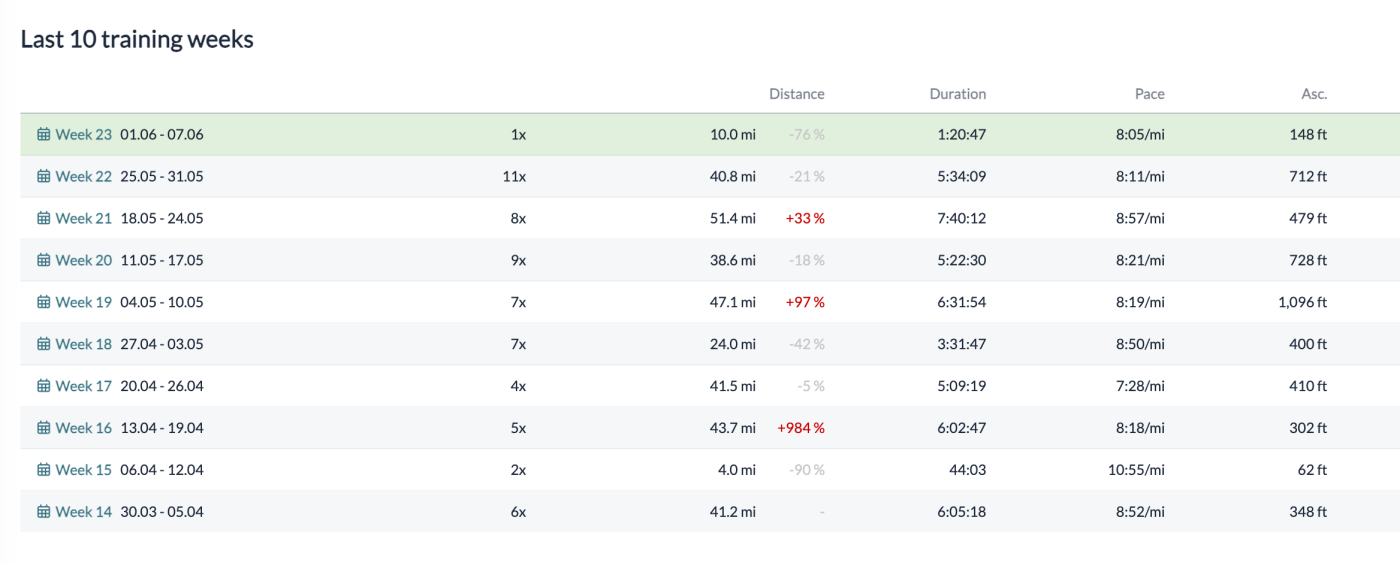
In terms of races I have had two Yorkshire Veterans Athletics Association (YVAA) Grand Prix races last month: Honley and Kirkstall. I won the M55 category at both, which was a nice surprise. At Kirkstall I came 16th overall and was 20 seconds faster than my previous course best according to Runalyze, which tells me the higher-mileage approach must be doing something. I’m at the upper end of the M55 category at 59, and Honley was a controlled threshold run while Kirkstall was preceded by a 4 mile run from the train station in Leeds, so something has been going on.
I’ve also peppered my mileage with a couple of harder parkrun efforts. Last weekend at York Knavesmire I finished in 18:46, aiming for a sub 19:00. It was threshold-ish, just shy of maximal. That was at the end of a big week of cycling which included a 100 mile ride to Hornsea and back.
I did make it onto the track too for a 1500 and 400 in the West Yorkshire League which were definitely training runs (5:09 and 1:15) but came at the end of a day when I had already run 7 miles in the morning to maintain the mileage for the week.
Just writing this I am realising I have been doing more intensity than I realise. My body keeps the score though. I have the beginnings of a sore hip again, which is a definite signal to back off. I still have one more 100 mile bike ride to do this week and then the following week it’s the 200 mile Vatternrundan in Sweden. Trying to sustain 40 miles a week of running with intensity on top of a considerable cycling load is a recipe for injury.
Continuity matters more than intensity, and if hard parkruns, track meets, and YVAA Grand Prix races jeopardise consistent mileage, then they will have to go. I must dial the intensity right back through summer and focus on getting the miles in at easy pace. That’s also the only way I am going to be able to train in the heat.
Making it bearable
If I’m going to run 40 miles per week through summer for the first time ever, I am going to need to make it tolerable. A few things I have done so far:
I shaved my hair short. Genuinely. I was tired of the post-run faff of sweaty hair, so I’ve taken my clippers to it. Weekly maintenance with the clippers, quick to wash in the shower, and much cooler on the run. This is my summer look. My daughter said, “You look like an army person.”
Cold drinks, ice, a soaking wet towel around the neck before a race, whatever I can do to cool myself down. One of my friends laughed at me at the YVAA when I turned up with a towel around my neck. But it worked.
I haven’t avoided the sun, I’ve embraced it. I can’t bring myself to get up at 6am to run when it’s cool but I can run slower than usual when I go out at midday. Sunglasses help protect my eyes from the worst of the pollen, which peaks late morning.
I’m already broken my soberish pledge and I am not going 100% alcohol-free this summer. But I am considering beer as a treat to have in the sunshine this summer after a run. The alcohol-free decision earlier in the year was part of the race build, but now I’m firmly back in base phase. A beer in June won’t cost me in terms of my April goal, but the continuity will fail if the whole thing becomes joyless.
I’ve also started to reduce my caffeine intake down to one cup of tea in the morning. This is making a big difference to my sleep already and it has got me thinking about one of my best performances in 2025 which was off the back of being caffeine free for three weeks. But more about that another time.
The bottom line is that this is not going to be an all-or-nothing off-season. It will be a reduced-intensity off-season, but the miles will continue and everything else will be modified to support that goal. Hair included.
The effect of heat on the body
Last week I ran 14 miles from Selby to York along the Trans Pennine Trail. It’s predominantly an old railway line, so flat and traffic-free. In fact if you watch other running videos on YouTube, it’s the same path Phil Sesemann and Alex Yee have been filmed training on. Just miles and miles of dead-straight tarmac stretching out in front of you which is great for mental toughness as well as pounding out some serious mileage.
The data from that run is worthy of closer examination because it reveals something stark about how heat affects the body while exercising. It was 25°C that day and a very hot day for me to be out running. I held my pace at just under eight-minute miles, with regular hydration and fuelling was on plan. My blood glucose levels were stable throughout. Nothing changed dramatically in my pacing for the first twelve miles.
My heart rate was a different story.
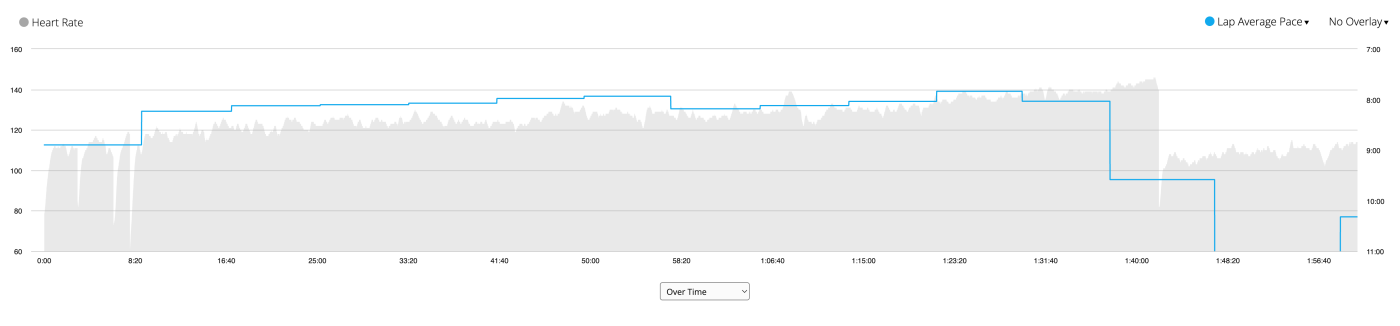
My heart rate settled in the low 120s, and sat there comfortably for the first ten miles. It then began climbing until at the end of the last three miles it was at 140. Same pace. Same dead flat road. The only variable was the accumulated heat load.
I ended up stopping and then eventually jogging the last mile when I had cooled off.
The cost of running in hot weather is not just subjective. The heat places an extra stress on your body. Your heart has to send more blood to the surface of the skin to dissipate heat. Less blood is available for the working muscles, which means the heart has to beat faster to maintain the same delivery. Hence the heart rate rise despite maintaining a constant pace. For me, running at 8 min/mile pace in 25°C, it resulted in 20 beats per minute of extra cardiovascular effort for no extra work output.
I was forced to slow down to keep my run ‘easy’.
This is one reason why summer miles can be valuable. That 20-bpm drift is also 20 bpm of extra training stimulus per mile. I wasn’t running faster, but the heat made each mile cost more.
Of course as an older athlete it is important to be careful to not force yourself into a state of heat exhaustion. But if you can work with the heat as I did on this run you can get a slightly harder workout for the same pace, for free.
But there’s more.
How the body adapts to heat
The body acclimatises to heat over time, and most of its adaptations carry performance benefits for endurance athletes.
The main adaptation is an increase in blood plasma volume. Within about three days of consistent heat exposure the liquid component of your blood expands. This results in a rise in stroke volume and your heart rate dropping at any given pace.
A slower-developing adaptation is the production of more red blood cells to compensate for the dilution caused by the increase in blood plasma volume. That takes weeks, not days, and short heat protocols won’t capture it. But a whole summer of training might.
Heat has been dubbed “the poor man’s altitude”. Both cause your cardiovascular system to run more efficiently.
Plasma volume adaptation and red blood cell production decreases within a few weeks of removing the heat stimulus. So a hot summer of training won’t make me directly faster for London 2027, but my body will get used to the heat and the training will get easier.
There’s also sweat adaptation. You become more efficient at sweating with sweat that is more dilute and fewer electrolytes are lost. That one matters for me specifically because I lose a lot of fluid in heat. Anything that reduces the salt loss is welcome.
For someone managing diabetes with a closed-loop insulin system, there’s another layer of adaptation to consider. Heat changes insulin absorption rates, alters glucose dynamics, and compounds dehydration risk. That’s not something I will cover here, but it’s why you see the warning sign on saunas for diabetics.
The plan from here
I’ve scheduled a few milestones for the rest of the year to keep me on track.
Just over a week from now is Vätternrundan. That’s a 200-mile bike ride around Lake Vättern in Sweden. That’s my big cycling challenge this year with the Type 1 Diabetes Cycling Team. Once that’s done I can afford to let the bike volume drop and just do a bit of commuting to York, a bit of Zwift TTT and ZRL later in the year, and the occasional social ride over summer. The running becomes the priority.
After Vätternrundan, I will keep the summer mileage at 40 a week and then push it up to 50 in August as I have more time during the school holidays.
In September I have the Knutsford 10K booked in for the end of the month. That’s based out of Barclays Radbroke Hall where I used to work and I am sure it will be along my old training routes. It’s got personal meaning and I hope to meet some old friends there. My target would be 38 minutes depending on the conditions. I would like to think I can hold 6:06 pace with a group on a fast and flat course.
October 17th is the Yorkshire Marathon. I’ve entered but I won’t be racing it. My plan is to run the first half at sub-3 pace with the 3:00 pace group. It’s possible someone I know will be pacing that group, possibly Mark Thompson or Wayne Fennell, so it should be fairly sociable. And, if my heart rate stays low enough, I can push on at the same pace for as long as possible. It will be a training run for London 2027 and a chance to practise carb loading and race fuelling again. If I hold up past mile 18 at pace, then that’s the durability proven from the higher mileage approach. If I don’t, then I still have time for a rethink before I start the January build for London.
Either way the Yorkshire Marathon will be a valuable test, and it’s definitely going to help me keep putting mileage in the bank.
After Yorkshire, I can afford to recover then start a build for the Brass Monkey Half Marathon in January where I will target sub 1:20. Basically trying to extend 6:06 pace to 13 miles. Again, this will provide valuable data for the London sub-3 attempt. Anything sub 1:25 and I will have a crack at sub 3. The closer I get to 1:20 then the more aggressive my attempt will be.
That’s the plan. The key is to maintain the mileage between June and September, where my summer training has normally fallen apart. This year it doesn’t, because I need continuity this year for my Spring 2027 sub 3 goal.
Closing
Ullrich never did a moderate version of an off-season. He was either Tour-de-France fit or Nutella-through-a-straw, with not much in between. He still won Le Tour, but he was 24 not 59! I am not young enough to emulate his approach any more.
For me, this summer isn’t about being Tour-de-France fit, or even race ready. I’m not planning on training hard and doing track workouts. I’m running 40 to 50 miles a week, mostly at an easy pace, and racing the occasional Yorkshire Vets Grand Prix event and parkrun at a non-maximal effort to keep the zip in my legs and to satisfy my social appetite.
Heat acclimation over summer will be a nice bonus that may also improve my autumn performance.
The 2026 in 2026 project continues. See you in July when, in the words of Glen Frey, the heat really will be on.
