
Why a DNF is not a failure
Last Sunday 18 October I ran 19.6 miles of the Yorkshire Marathon. Then I stepped off the course and took off my bib. This post, and the video that goes with it, is about that DNF: the race I did not finish.
Since Sunday, lots of people have asked me how the Yorkshire Marathon went. When I tell them I bailed out just short of 20 miles, they offer their sympathies and commiserations, almost as if I have been diagnosed with a serious illness or someone close to me has died.
For me, a DNF isn’t like that. This one was close to planned. Stopping before the finish was a serious option from two weeks before the race, and in this post I want to explain why, what I have learned, and what changes for my marathon build for London 2027.
For anyone new, my goal for the London Marathon 2027 is a sub 3 at 60.
The last two weeks
The reason for my DNF at Yorkshire can be most straightforwardly traced to two weeks before the race. At that point I was experiencing a pain in my left calf, which morphed into shin splints. I couldn’t run and so the week of 5 October I just walked and cycled. In race week I managed just a few easy runs, 13.5 miles in all, but my legs didn’t feel good at all. It was 50/50 whether I would start the marathon at all.
I decided to give it a go with the option of bailing out in the city centre early on or at the out and back section in Dunnington much later on. The first few miles my legs felt very flat. At 5K I knew it was not looking good, but I was happy to persevere in the hope I might settle into the pace as the race unfolded.
At this point I was with one of the sub-3 pacing groups and chatted to Mark Thompson, the marathon machine, who was leading it. He looked across and asked, “Are you going for it today?” My honest answer was, “I’m just hanging with you as long as I can, Mark.”
That certainly was my plan before the start. I would try to hang with the sub 3 pace for as long as it was comfortable. As soon as things got too difficult, I would drop off the pace and potentially not carry on.
This was to be a dress rehearsal for London next year rather than a race in itself.
Sub-3 pace until my legs said no
The first 5K was uncomfortable, and so was the next 10K. All the way through to the half it didn’t feel easy, and the first half of a marathon should feel easy.
My heart rate was in the right place. It averaged 146, below 150, my marathon heart rate target, so my heart and lungs were fine. But it was my legs that were the problem. They were sore, heavy and stiff from the start. All the signs that I was in for a difficult day.
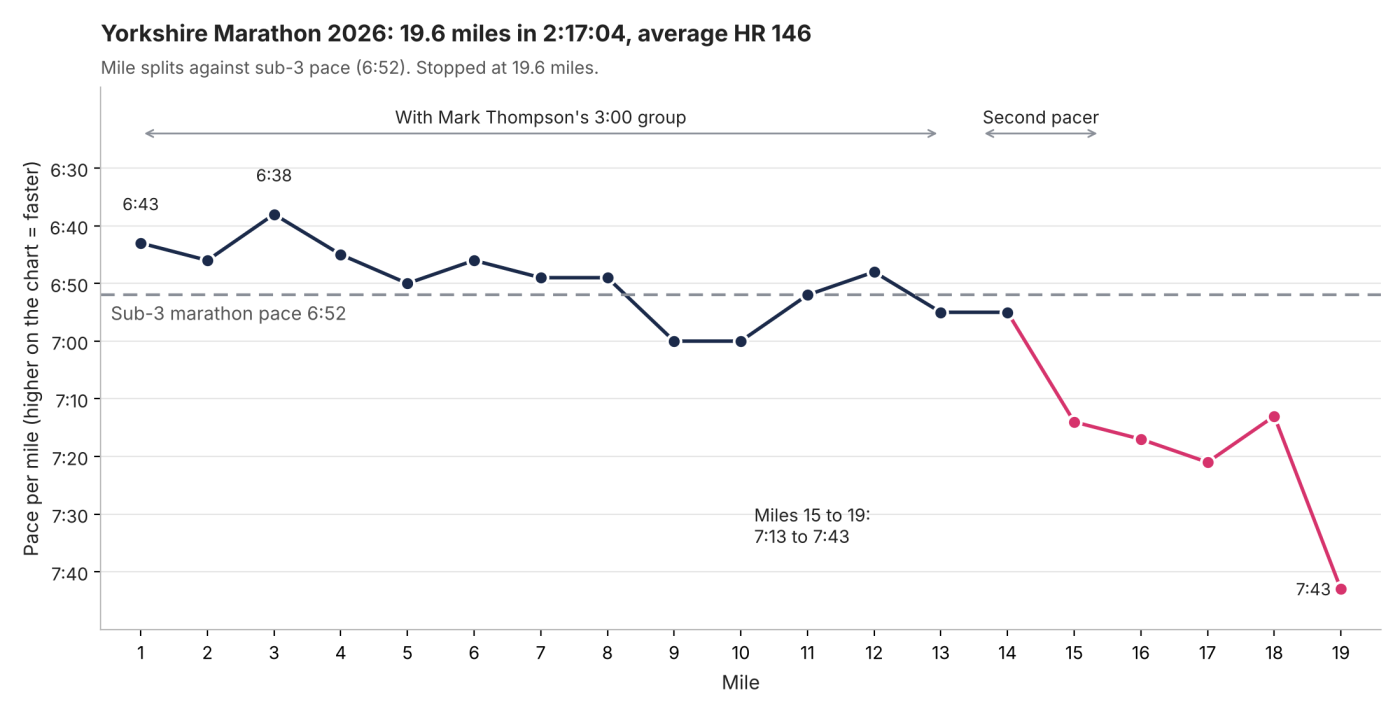
The pacing in the sub-3 group was a little faster than I’d hoped. Mark was taking it out at 6:45s and 6:46s, so there was a buffer on 6:52 sub-3 pace early on, but it felt too fast for me. I hung on to halfway, then dropped off Mark’s group. A second 3-hour pacer was a little way behind, so I tucked in with this group for a couple more miles.
Then that group started to feel too hard as well, as I looked toward the long drag from Stamford Bridge up towards Dunnington. By mile 14 I had dropped off the pace and was looking for options to stop.
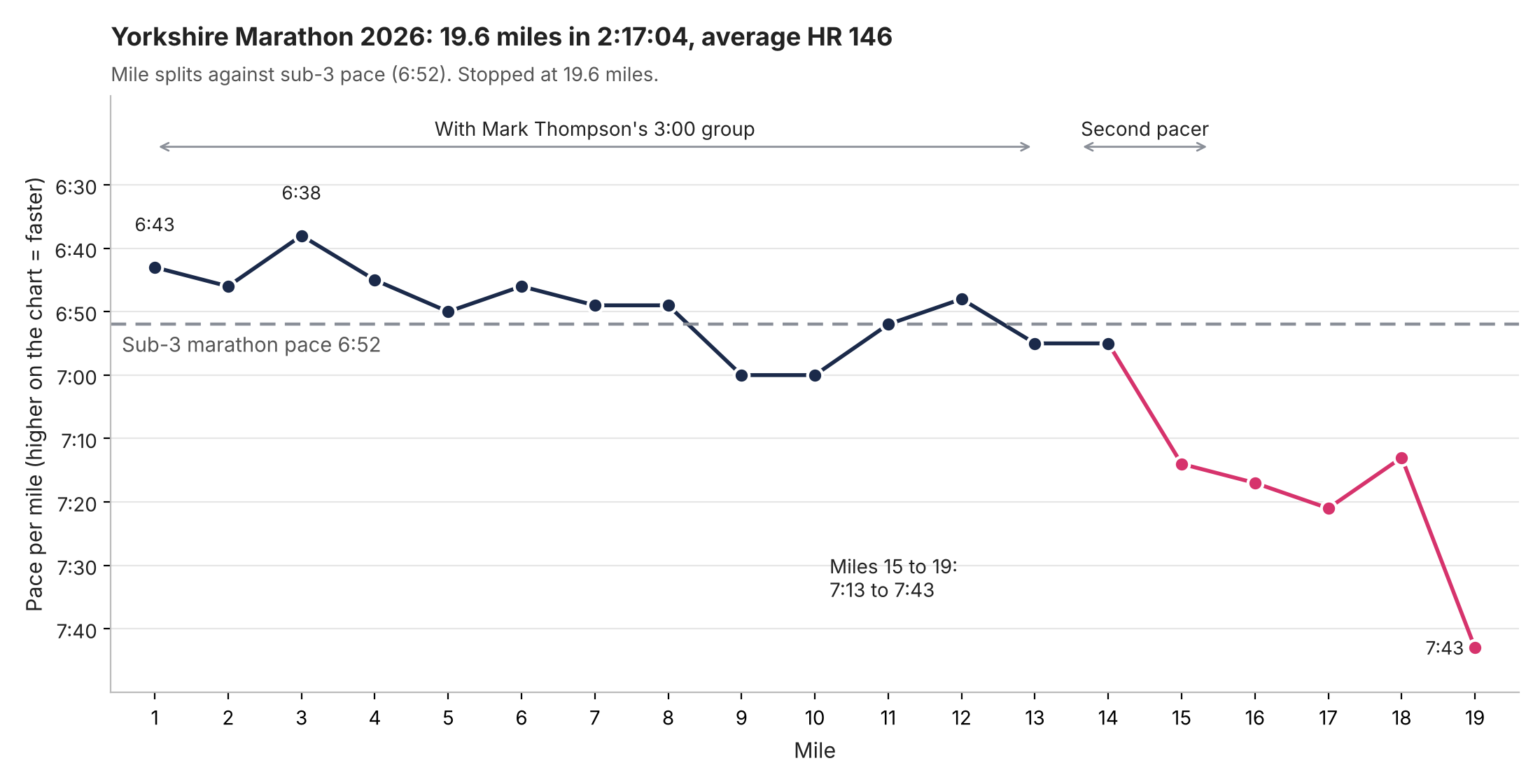
CHART 1: mile splits in relation to sub 3 pace (6:52 min/mile). Navy line is the miles with the pacers, pink is after mile 14 when I dropped off the pace.
While the crowds at Stamford Bridge and Dunnington were really supportive and it was heartening to see fellow runners and friends on the other side of the road during the out and back sections, I had made up my mind to stop when the opportunity arose.
The stop: pump and sensor
Around mile 15 I saw two friends and club mates, Donna and Beverley, on the other side of the out and back at Dunnington. I shouted across: “Have you got a car with you? Is it nearby?” They said yes and my mind was made up.
I would finish the out and back section, get round to their side of the road at just short of 20 miles, and step off.
I stepped off and checked my insulin pump. The cannula, the part that goes into my body, is held on with an adhesive patch. It had come completely loose, so I wasn’t getting the insulin I needed. Even if the legs were good on the day, this would have been a good reason to call it a day.
To make matters worse, my continuous glucose monitor, which is also stuck on with an adhesive patch, had come loose too. Its readings weren’t valid, and the alarm on my phone started, telling me my blood glucose readings were abnormally low. The alarm sounds like a baby crying: a fitting end to my Yorkshire Marathon.
I ripped off what remained of the adhesive patches as we walked back to the car. I felt relieved not to be running any more and I was happy to cheer on those who were.
What I learned
A DNF is not the end of the world, and it certainly isn’t a failure. It is a learning experience.
I have DNF’d a few times before: through injury, when my head wasn’t in the game, and sometimes as a planned dropout because it was a training run and I didn’t need to go the full distance. This is what I have learned from Yorkshire.
1. Two weeks of little to no running cost me my legs
Barely running in the two weeks before the marathon, a week of walking and then just a few easy runs, was a death knell for my legs. I probably shouldn’t have done that, but I was managing the calf pain and shin splints. In retrospect, I probably should not have started the race. My shin is sore now, and it will take a few weeks of complete rest before I can run again.
It is nigh on impossible that I will reach my “2,026 miles in 2026” target now. I sit at 1,540 miles with 10 weeks to go. I am going to need at least 50 miles a week when I return from my holiday in Tenerife and that assumes my calf is completely healed.
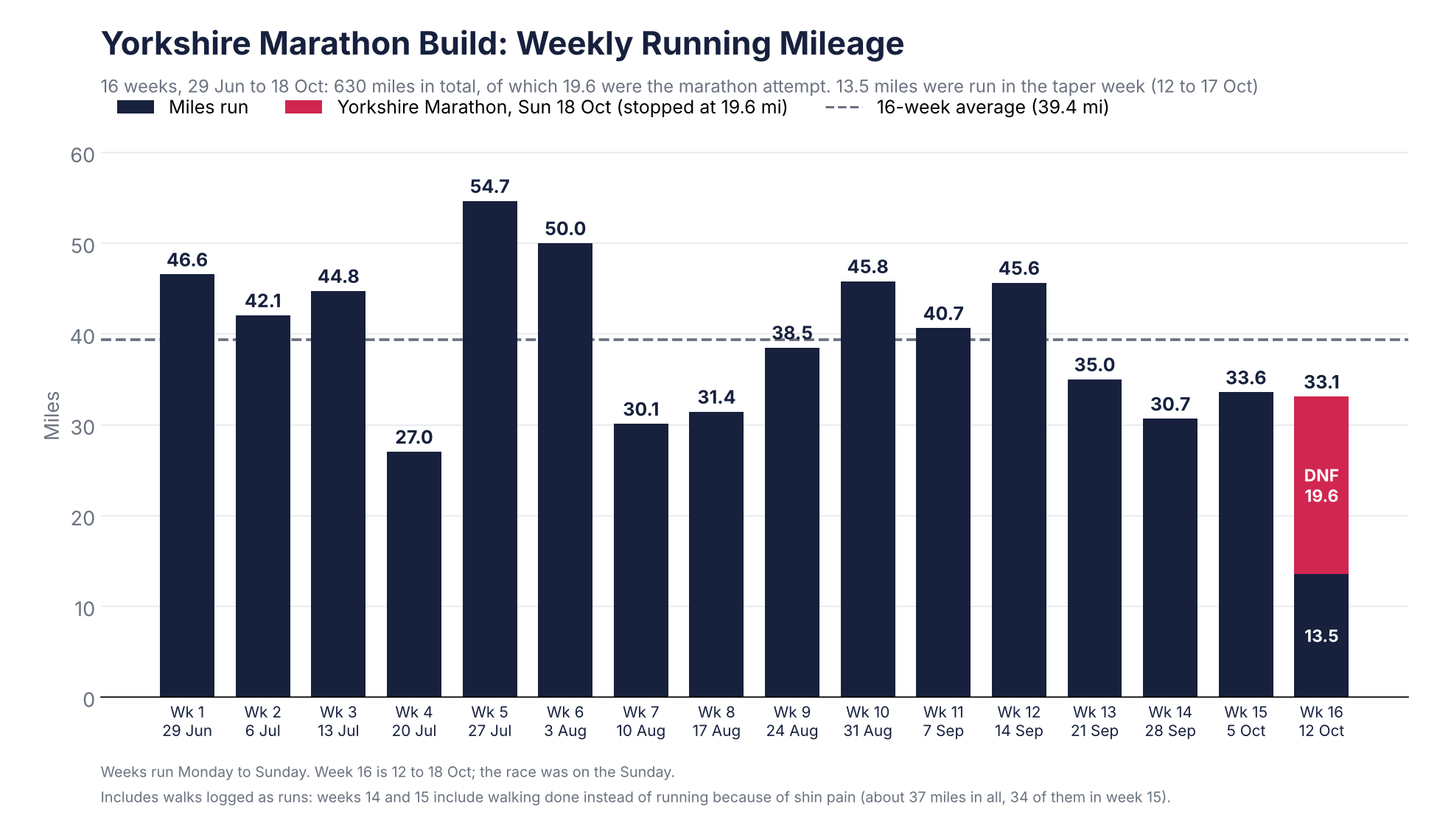
CHART 2: Weekly mileage for the 16-week Yorkshire Marathon build. Week 15 (5 to 11 Oct) shows 33.6 miles, but all of this was at walking pace because of the shin. Week 16 includes 13.5 miles of easy running before the race.
2. Better adhesive for the pump and sensor
I need to sort out better adhesive for my insulin pump and my glucose sensor. Sweat, moisture and water from running at pace for 20 miles are what loosen the patches, so I need to secure them better for London. It is hard enough running a marathon without worrying about not getting insulin on board, and not being able to rely on accurate blood sugar readings.
My nutrition was on point with an SIS Beta Fuel (40g per sachet) every 3 miles plus an on-course gel (23g) where they were available. This made for approximately 100g per hour, and if the insulin pump and sensor had held up, it would have been enough to see me through.
3. More marathon pace work
My block didn’t include enough marathon pace work in it. I did a lot of very easy running, chasing 2,026 miles in 2026, and I enjoy the faster running, at 5K pace and quicker. Marathon pace, which is what I really needed, sits in between these two extremes, and I should have done a lot more of it.
For the London build I will do a lot more marathon pace work and keep the faster stuff limited to little sprinkles. Sub-threshold, edging towards threshold, will have to be my sweet spot going forward.
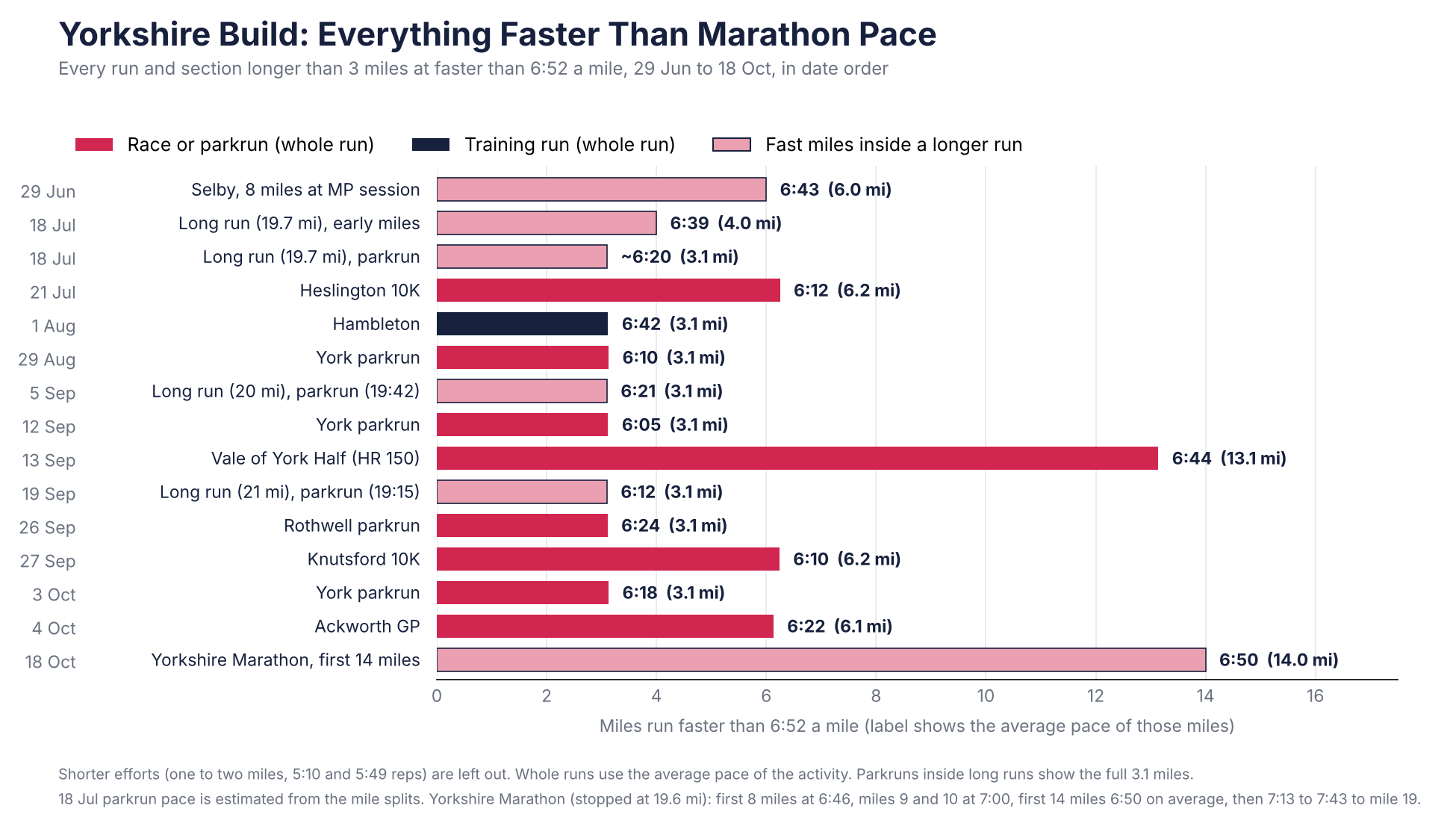
CHART 3: everything faster than marathon pace. Most of the bars are parkruns and races. I find it difficult to run at MP in training.
4. Sixteen weeks was too long
This marathon block was 16 weeks, off the back of a lot of running earlier in the year in the heat. I think 16 weeks is too long a block for me.
Four weeks before Yorkshire I did my last long run, a 21-miler, and it felt great. If I had been running the marathon that day, I think I would have been in my best shape of the block. That is where I want to end up for London, so I am going to limit myself to a 12-week build instead of 16.
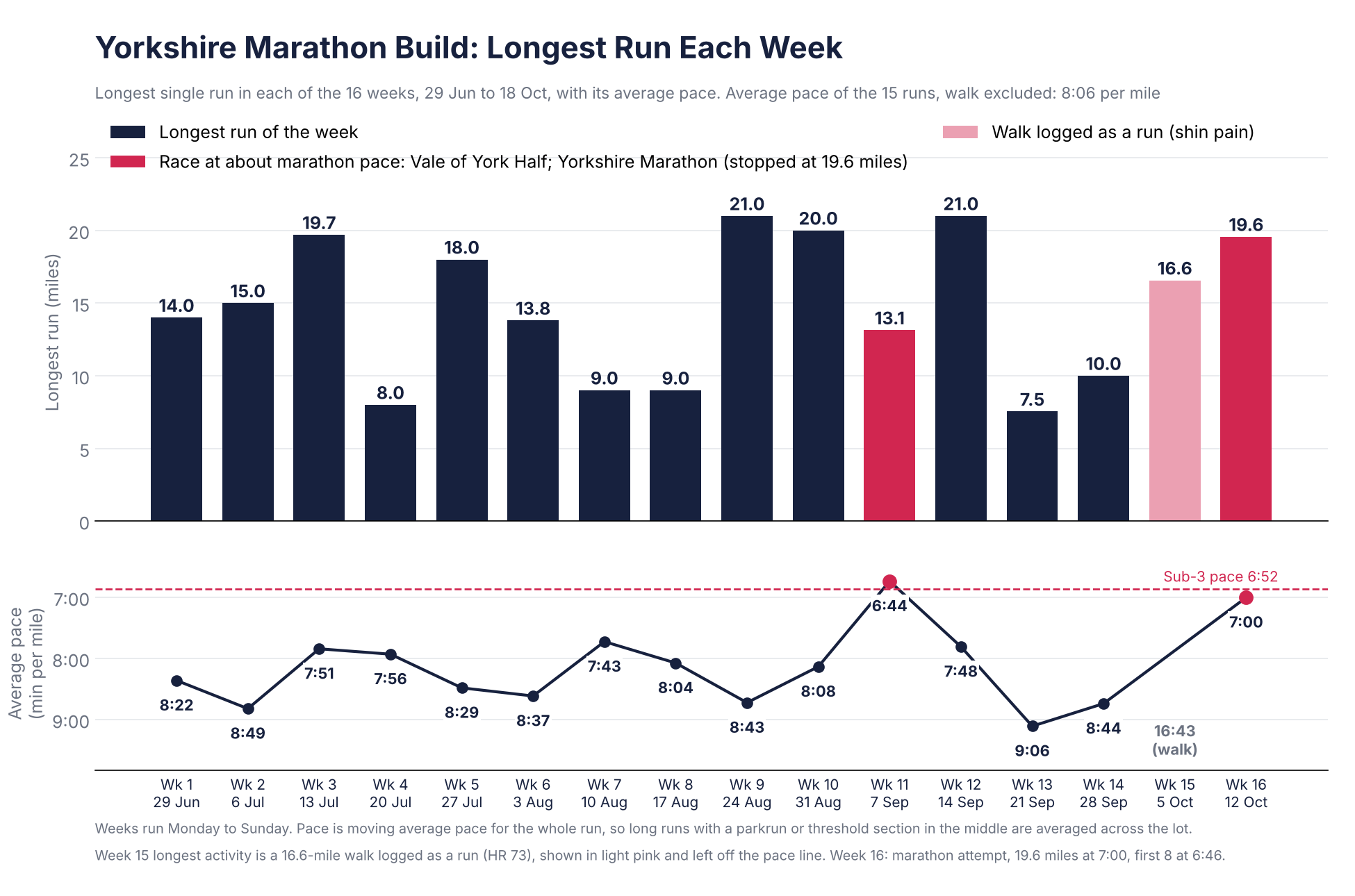
CHART 4: longest run each week. The 21.0-mile run on Saturday 19 September, 29 days before the race, average heart rate 129.
5. Mileage matters less than I think
I ran more miles in the lead-up to the Yorkshire Marathon than I had ever run before. At 610 miles it easily beats any build I had done before.
This year I am also on target to run my biggest yearly running mileage ever.
But there are no medals for who runs the most mileage leading up to a marathon. And it certainly didn’t correlate with an improved performance for me.
Take a look at this final chart that shows the mileage for each 16-week build in all my recent marathons over the last 12 years.
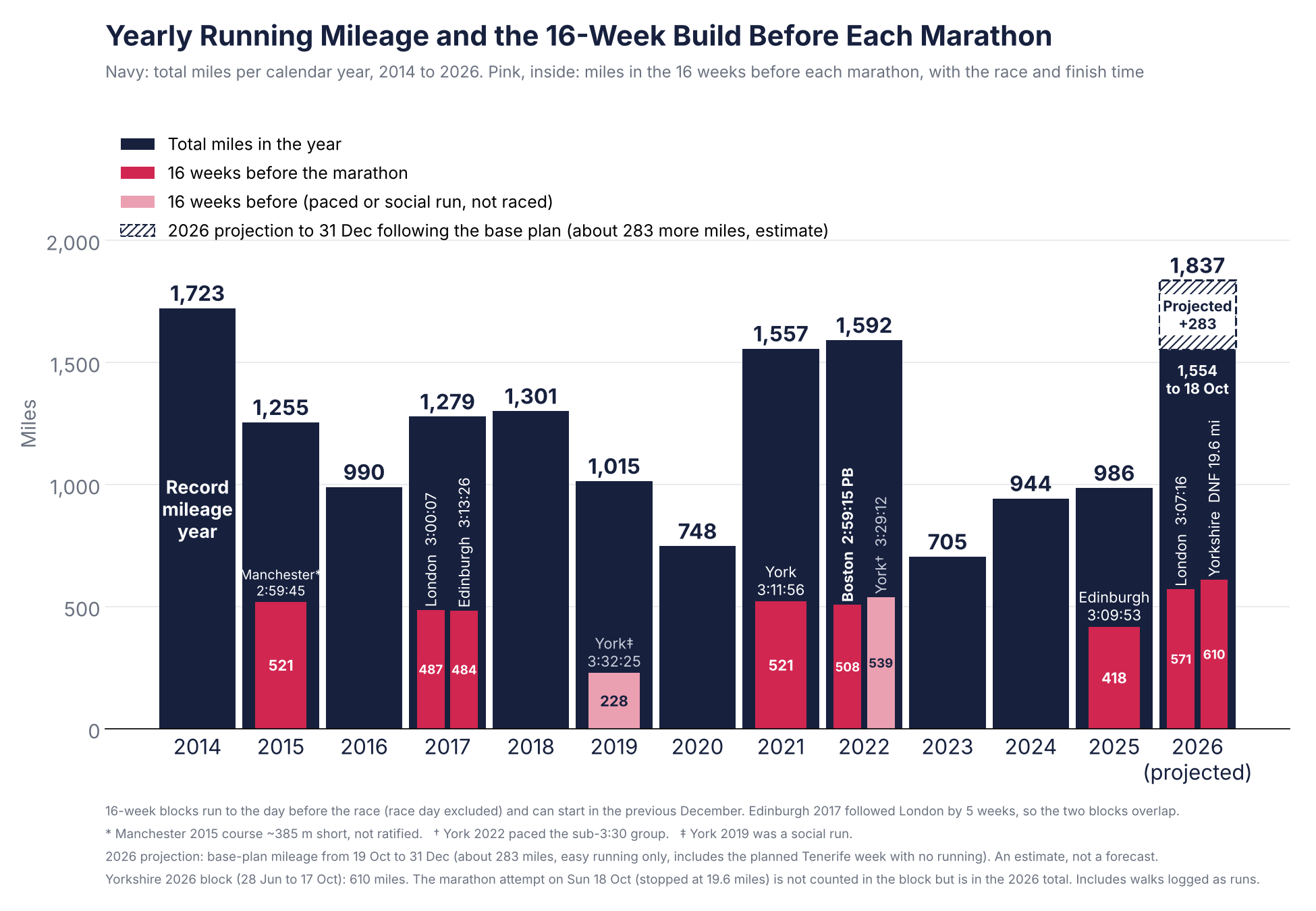
CHART 5: miles in the 16 weeks before recent marathons. Yorkshire had the most miles, 610, against 508 for Boston. Boston was a PB and my only sub 3, so the extra volume for Yorkshire didn’t buy me anything.
I ran a 3:00:07 at London on only 487 miles. This may have been nearly 10 years ago, but it was pre-super shoes. My 2:59:25 at Boston was done on 508 miles.
Mileage doesn’t matter as much as I think. If there is one take-home from my 2026 in 2026 project, it’s that while it’s fun to have a goal that has kept me running through the summer, the mileage should not be an end in itself for improved performance.
London 2027: what changes
I have time to put these changes in place before London. My plan will be:
- A 12-week block, not 16. The target is to arrive at the start line in the shape I was in after that 21-miler in this block.
- More marathon pace work, from the start of the block. The faster running becomes little sprinkles.
- Marathon pace races to keep me sharp. I will use races like the Liversedge Half at Roberttown on 7 March and the Spen 20 at the end of March, as my sharpening and tapering towards the marathon itself.
And one final change. If my legs feel bad two weeks before London, I am not going to run it. There is no sense in me running that one as a dress rehearsal for a sub 3. That will be the real deal. There is no easy place to bail out and DNF in London, and I do not want to crash and burn there with no support.
I will aim for the sub 3 at 60 as planned, and try my best to make sure my legs feel good going into the race. For now, it’s time to head off to Tenerife for a week of rest and recovery before I start running again in November.