
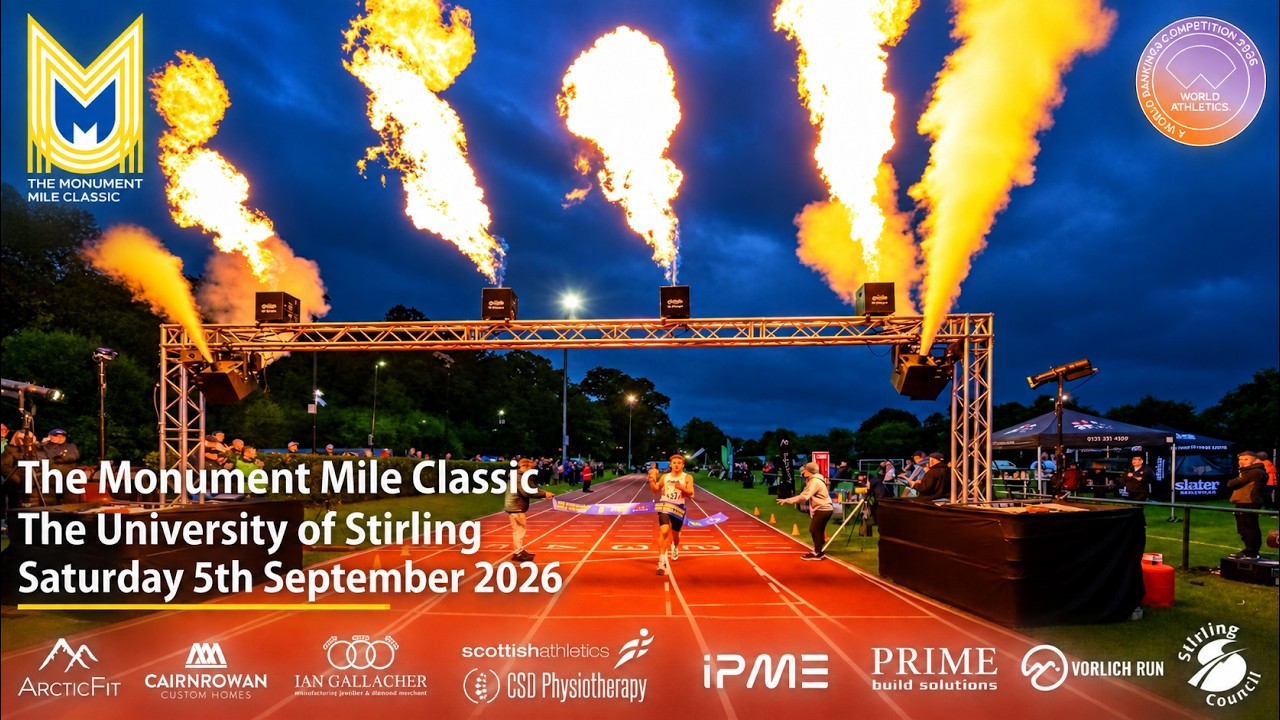
The full stream is over five hours long. This video starts right at the beginning of Cameron’s race.
A mile in 4:21.74
University of York student Cameron Bryson ran 4:21.74 at the Monument Mile Classic at the University of Stirling last Saturday, 5 September, to set a new Vale of York club record.
About the Monument Mile
The Monument Mile is not your conventional track meeting. Now in its ninth year, it consists of over thirty seeded mile races run back to back over five hours on the track at the University of Stirling. There are flamethrowers, live streaming and a party atmosphere.
Everyone is seeded with athletes of a similar ability, from juniors trying to break 7 minutes in the very first race to elite men breaking 4 at the end. Cameron went in Race 29 towards the finale of a very busy evening.
Consistent training
Cameron’s previous best for the mile was 4:25.54, set in 2025. Saturday took nearly four seconds off that. What has happened in between?
A steady build and a regular presence at the Monday, Wednesday and Saturday University of York track sessions, as well as being a stalwart of the Sunday long run, have been the mainstays of Cameron’s training whilst in York.
He was the club’s leading senior man through last winter’s West Yorkshire cross country series, taking the team to fourth in the league. On the road this year he set PBs in the 5K and 10K of 15:31 and 33:31 just two days apart in April at the Isle of Man Easter Festival with a multi-terrain hill race in between!
A 1500 PB of 3:55.68 at the BMC meet in his home city of Exeter in July showed the speed was still there in his legs over middle distance. It was then a case of further sharpening before a last big effort at the end of the season.
Laying it on the line
Like the 1500, a mile is a different kind of beast to a 5K or a cross country race. It is short enough to hurt from the gun, but long enough that there is nowhere to hide when the going gets tough.
Metabolically it places a heavy demand on two energy systems. Roughly three quarters aerobic and one quarter anaerobic, run at or above the speed that demands maximum oxygen uptake for almost the whole race. Blood lactate levels at the end of a mile are about as maximal as distance running gets.
Then there is the raw speed required for the mile. Cameron’s 4:21.74 is 65 second laps. His 5K best of 15:31 averages 74 and a half. That is nine and a half seconds a lap quicker, and that speed has to come from somewhere: a longer stride, more force into the track on every step. It means recruiting the biggest and fastest motor units, then holding on to them while the acid does its best to switch them off. You will see from the video that the last 200 is a sprint on legs that no longer want to sprint.
And all of this happens in the middle of a crowded pack. Positioning is all-important. Going wide on the bends or responding to surges costs you energy you don’t want to spend, while getting boxed in against the rail breaks your rhythm and risks a fall. Knowing where to position yourself and when to commit is as much a part of the event as the miles and miles of training that get you there.
The mile is by no means an easy event to train for and take part in, it’s one that demands consistency in training and courage on the day to toe the line and give it your all.
Congratulations, Cameron, on laying it all on the line and coming home with a club record and an impressive PB.